Bagan and Mrauk U – a double temple-fest

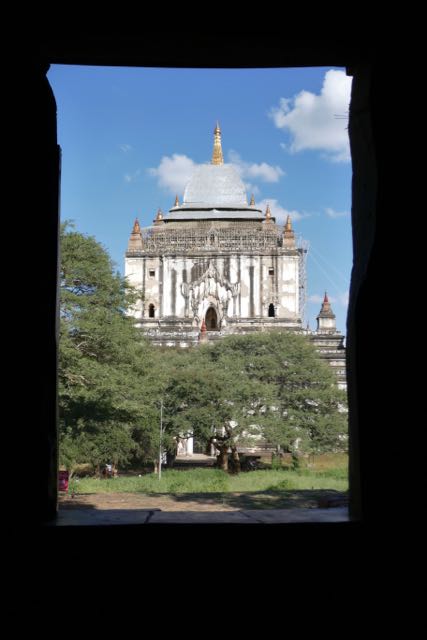
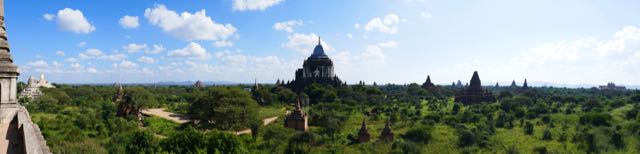
view from Shwegugyi, Old Bagan

Looking back on my eight days wandering around Myanmar’s two most famous archaeological sites, I realise that so much of what I would say about one is by reference to or in contrast with the other, I thought I’d write about them together.
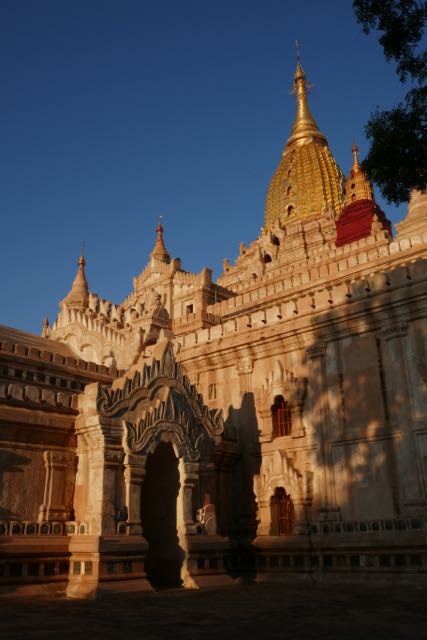
Ananda Paya, Bagan

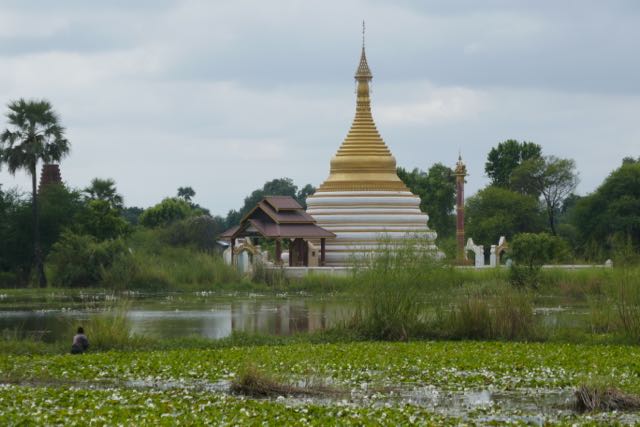
Bagan tends to be regarded as THE must-visit site in Myanmar. Even Yangon’s Shwedagon Pagoda and Inle Lake, with its leg-rowing fishermen, take a back seat to this extraordinary 40 square mile area and its two/three/four/ten thousand temples, pagodas and monasteries (no two sources come up with the same number either of those constructed or of how many remain) from the eleventh to thirteenth centuries when Bagan (Pagan) was the capital of the Pagan Empire, the first kingdom to unify regions that would later constitute modern-day Myanmar.

Buddha, Shittaung Paya, Mrauk U

As for Mrauk U (pronounced “miao-oo” locally), only the cognoscenti, or so it appears, have heard of this former capital of the dominant naval and international trading nation of Arakan, and its slightly more modest collection of temples built in the fifteenth to eighteenth centuries.
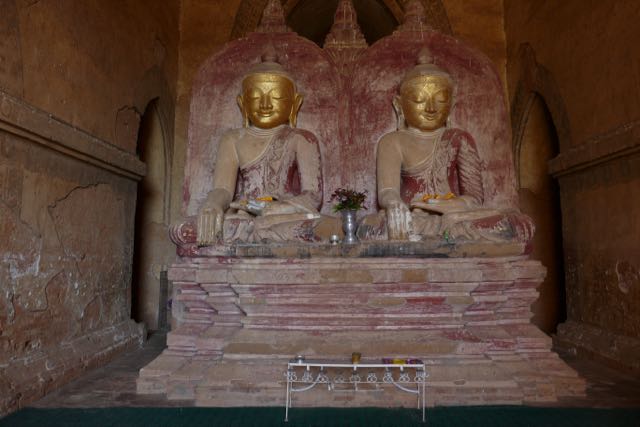
Gautama and Mairtreya buddhas side-by-side, Dhammayangyi Pahto

Bagan is highly accessible, the Nyaung U airport at the eastern edge of the temple-littered Bagan plain receiving direct or tourist-route flights multiple times a day.
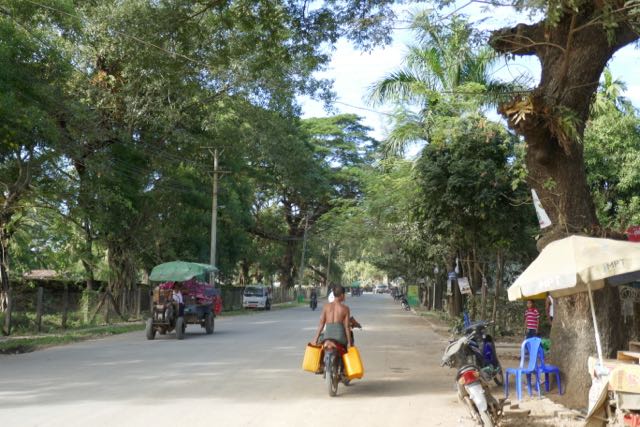
near Mrauk U town centre

Mrauk U doesn’t (yet) have an airport. The only way to get there – if you don’t feel like 18-plus hours in a bus on winding roads – is to take the boat up from Sittwe, the state capital, having flown in from Yangon. The 4/5-hour boat trip is a lovely journey, though Sittwe itself has little to offer. It’s very much a working town; tourists aren’t anticipated or catered for. Hotels are basic, restaurants next to non-existent, and the most stunning building in town is the mosque, which is barricaded and crumbling, ever since the communal violence in 2012.
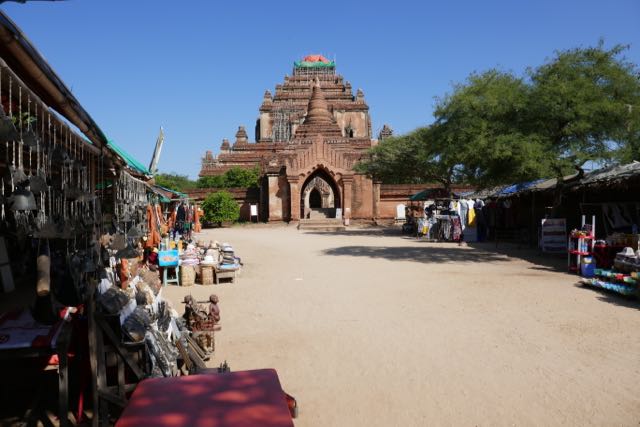
Sulamani Pahto, Bagan

Bagan is touristily-sophisticated. Each of the key temples is marked by a row of stallholders selling more or less similar memorabilia, and a greater or lesser forest of waiting transportation, though in neither way does it rival Siem Reap or any of the major sites in India. So far at least, the Burmese are far less pushy than their counterparts. The neighbouring town-lettes of Nyaung U and New Bagan are littered with hotels, bike rental places, and information/onward-travel-booking kiosks, and Nyaung U boasts a street several blocks long known unofficially as “Restaurant Row”. Bangkok’s Khao San Road it is not, but it’s the most tourist-focussed stretch of road I’ve yet seen in Myanmar.
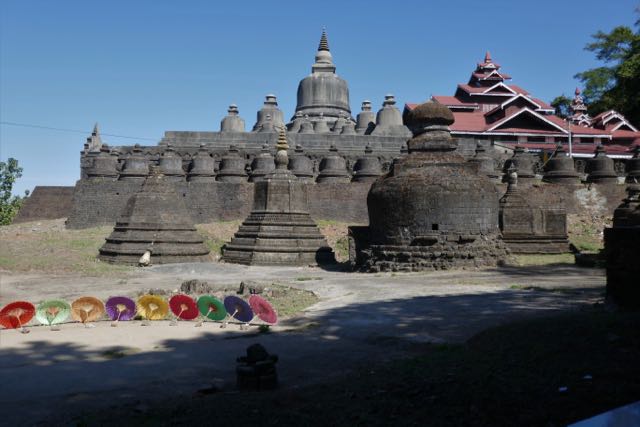
Shittaung Paya, Mrauk U

In Mrauk U, the only temple that has any accompanying touristiness is Shittaung Paya, the one place every (honest) foreigner must visit in order to pay the entrance fee for the whole site. Even here, I found far more locals and Burmese tourists than firangis. It’s as if Mrauk U hasn’t really woken up to the potential for international tourism, though its remoteness will continue to hamper its development in this regard and there’s no doubt that recent events, already affecting bookings in the rest of the country, will have clobbered tourism here in Rakhine state itself. Hotel options are limited, restaurants even more so, and there’s almost no ancillary services market. Even the tuk-tuks (here called “thoun bein”) seem shy in offering their taxi services. Firangis are unusual, stared at, giggled at (or with), English shyly practised by the more daring.
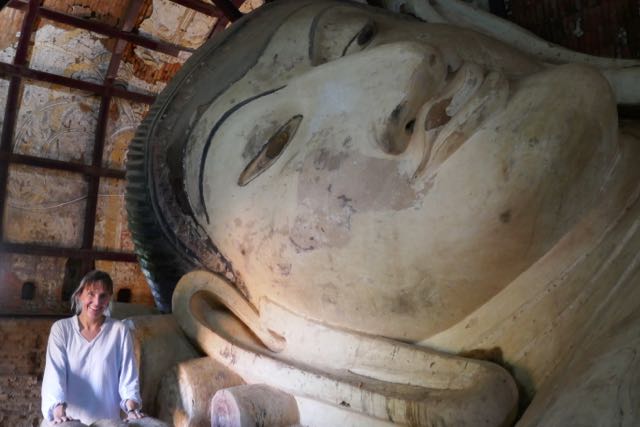
Yours truly and reclining Buddha, Shwesandaw Paya, Bagan

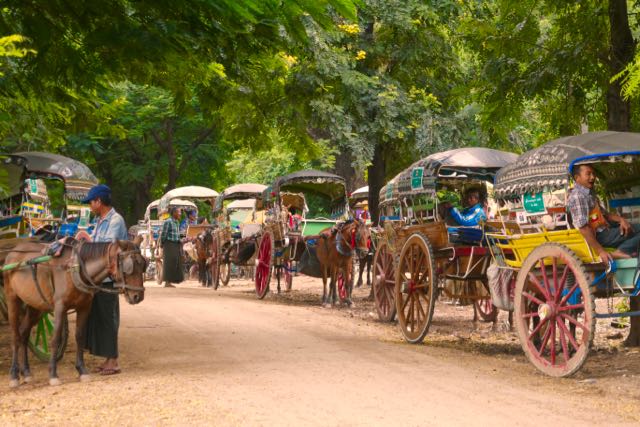
To explore Bagan requires transport. Even the walkaholic has to admit defeat here. With the government banning motorbike-taxis and thoun bein from the temple area, the tourist’s choices are a horse-and-cart, DIY bicycle or “e-bike” (a battery-fuelled moped), or, to the extent that it can make it through the sandiness of many of the tracks, a taxi.
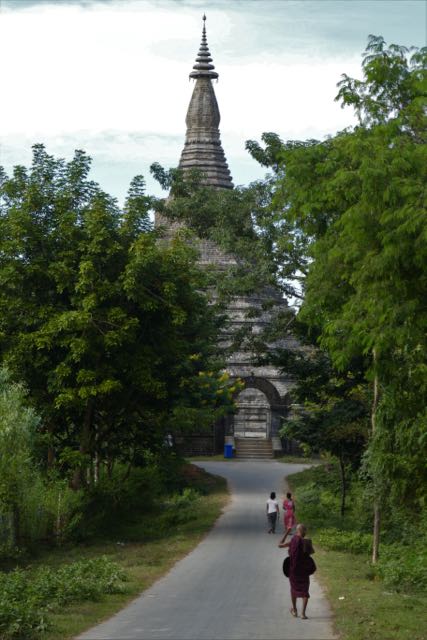
The majority of Mrauk U’s main temples are walkable. Yes, you clock up some distance and the temperature may not be everyone’s cup of tea, but it’s manageable and hugely rewarding. One day I was the only firangi I saw, and I had stretches of time where I didn’t see another soul. In Bagan I met a German lady who’d last visited the country 21 years’ ago. I wonder now whether the Bagan she saw then was like the Mrauk U of today, and envy her that Bagan.
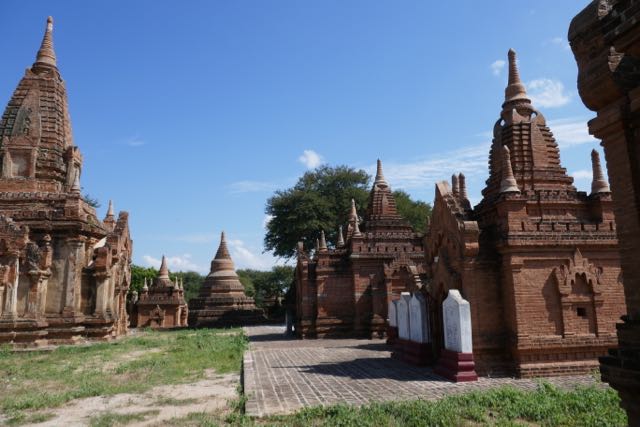
A panoply of temples

The majority of Bagan’s temples are built of a rich red brick with a smattering of white-washing and gold around; with only one or two exceptions, Mrauk U’s of a dark grey stone, and some so much more resemble defensive structures than religious buildings that they have been mistaken for forts.
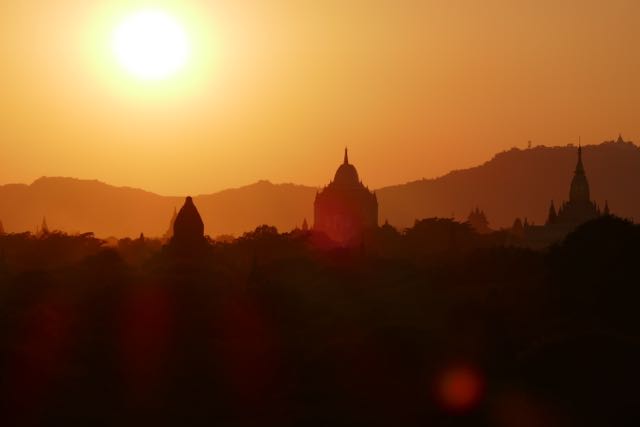
sunset from Buledi, Bagan

The Bagan plain has several settlements around it, but, with the exception of a couple of temples in Nyaung U and New Bagan, there is only a very limited amount human habitation near the majority of temples. The village that had grown up around Old Bagan’s monuments was forcibly relocated a few kilometres down the road in 1990, tourist hotels put up in its place as the government realised the power of tourism to bring in much-needed hard currency. The effect is therefore that the vast majority of the monuments are insulated from the real world. Yes, the Burmese who visit them often pray there, but, for the most part, these are not temples that are part of everyday life.
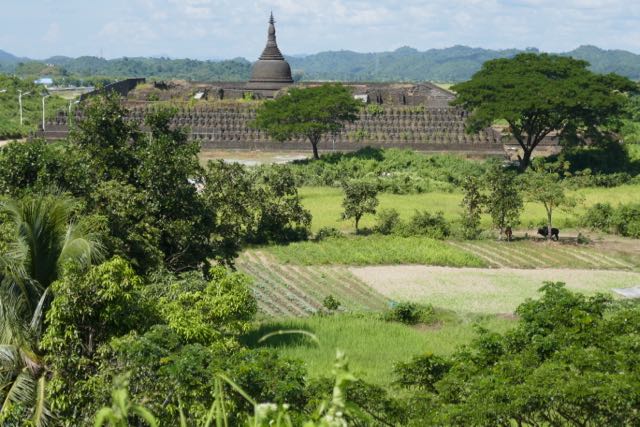
Temples and paddy fields – Kothaung Paya from Peisi Daung Paya, Mrauk U

In Mrauk U, on the other hand, there is a lovely immediacy and relevance to the temples. They are in the middle of paddy fields, up the hill from the nearby village, part of the furniture, as it were, and many have their own attendant monks and/or nuns: part of the here-and-now.
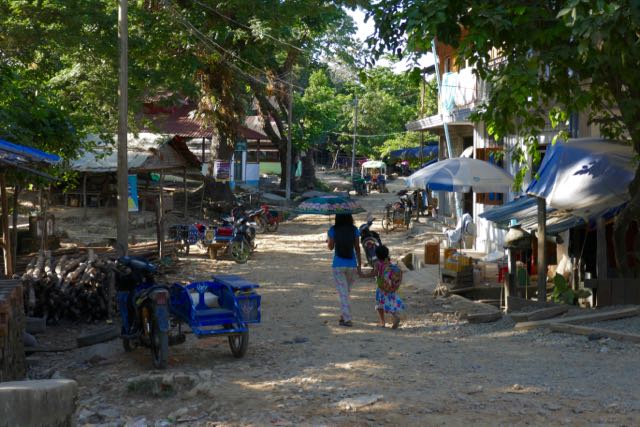
Central Mrauk-U

None of this is meant as a criticism of either place: they are simply very different, and I loved my time in each, even if I did feel as if I were clocking up an eye-watering number of temples each day. (I asked a friend recently for her recommendations for my weekend visa-run in Singapore – Myanmar only gives tourists 28-day visas – and she mentioned an area where there is a mosque, a Hindu temple and a church in close proximity. Wow, a religious site that isn’t Buddhist: that’d have an air of novelty, I thought.)
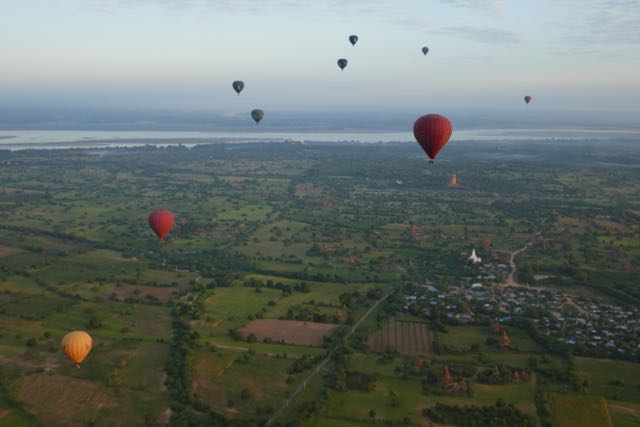
Balloons over Bagan

In Bagan, THE thing to do is to go for a hot air balloon ride over the monuments at dawn. Any later in the day and the temperature in this, one of the hottest parts of the country, makes flying infinitely less predictable, so the three companies operating balloons have decided to focus on the almost-guaranteed dawn departure. I was afraid I’d left it too late. The Balloons Over Bagan website said they had no availability until much later on in November. I was kicking myself: I’d planned my Bagan dates sufficiently far ahead that I could have booked it earlier had I only thought. With low expectations – even congratulating myself on the money I wouldn’t therefore be spending (it’s not cheap, of course) – I went into the “BOB” office the afternoon I arrived in Nyaung U. And ten minutes later came out with a booking for three days’ hence. All my virtuous thoughts about the unspent dollars went out the window; I had a happy grin meeting round the back of my head.
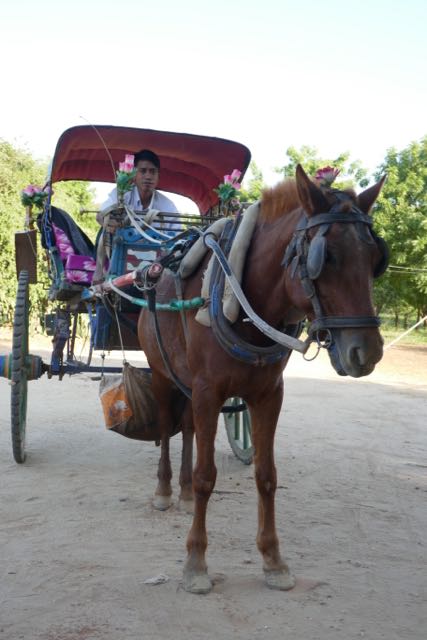
Konaing and MuMu

Just around the corner, Konaing (pronounced ko-nai) and his brother, Gotek, were to be the immediate beneficiaries of my bonhomie. “Taxi? Horse cart?” they asked me in unison. I paused. Well, I didn’t fancy cycling around the temples given the dusty, slippery condition of the tracks (and my ability to become, um, geographically challenged), and I had already been thinking that, in contrast to my piousness at Inwa, I would like to look at the horse-and-cart option here. And there was the possibility of a half-day trip to nearby Mount Popa for which a vehicle would be required. After a little discussion with the two men, and a short interview with Mu-Mu, the equine end of the partnership – you can tell a lot from the way a man treats his animals, and Mu-Mu was in good condition, to my relief – we had a deal. Konaing and Mu-Mu would take me round the temples the next day, and, all things being equal, Gotek would drive me to and from Mount Popa the day after. (I asked Konaing whether he’d be driving, and he said that, while he does have a driving licence, “I do not like speed”.)
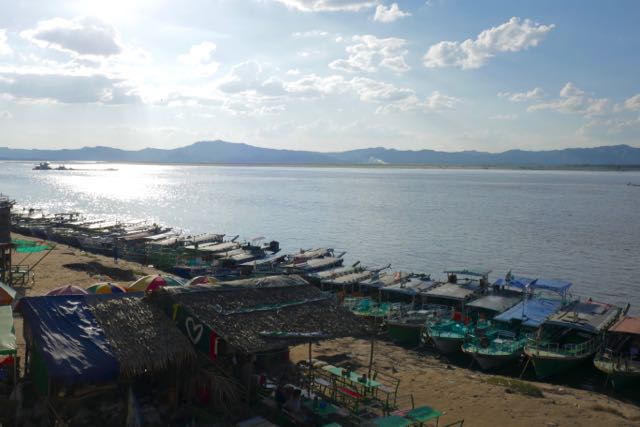
Sunset boats at the ready below Bupaya, Old Bagan

And so I found myself on the first of what were to be three new-to-me forms of transport in as many days. On the Tuesday, Konaing and Mu-Mu took me around the temples of the South Plain, the Myinkaba area and the North Plain. On the Thursday morning, I prised myself out of bed at 4.30am for my first (and, let’s face it, probably only) hot air balloon flight over the whole area. There’s a government-imposed restriction on flying over the Old Bagan temples, but, in fact, the key ones are so large that they’re eminently visible when you’re flying over the east and south of the plains. And on the Thursday afternoon, I braved the e-bike thing… and resolved to have a moped/scooter lesson when I got home. A right-hand-operated accelerator is definitely not intuitive, I decided, as I picked myself up out of the dirt having failed to switch the engine off before turning the bike around for a temple I’d just missed. (And some of my friends were thinking the ballooning was going to be the scary part!)
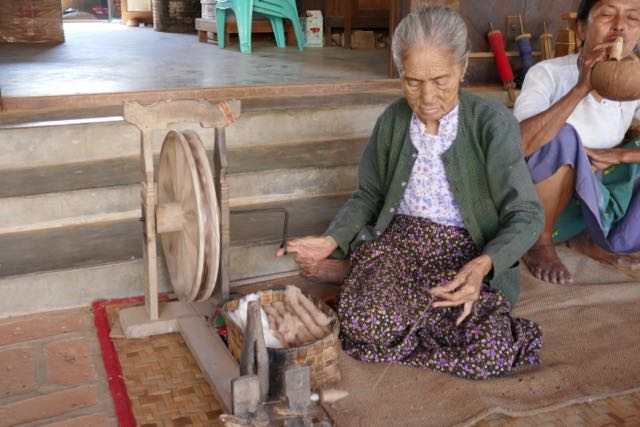
spinning, Minnanthu village

The day trotting around in a horse-and-cart was luxuriously relaxing. While I admit it’s not the most comfortable form of transport – Konaing’s cart is lined with foam mattresses, but the height of the canopy doesn’t anticipate European inches – it was wonderful to be pottering along so gently and quietly. Mu-Mu didn’t bat an ear or miss a step, no matter what other transport might have been doing, even on the short stretch that is as close as Bagan comes to dual carriageway, with its occasional buses. I made sure to thank her each time I dismounted for a temple – all, um, fifteen, I think, that I visited that day – and to ask her if she was all right to continue each time I re-mounted. Konaing seemed touched at this, and he was clearly very considerate of her himself, making sure to rest her in the shade and imposing a lunch stop that was primarily for her benefit rather than ours.
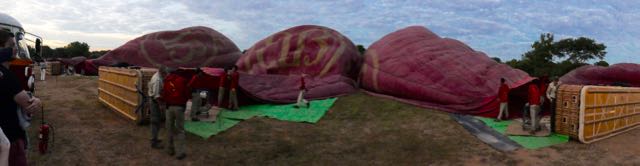
Inflating the transport
Balloons Over Bagan official picture

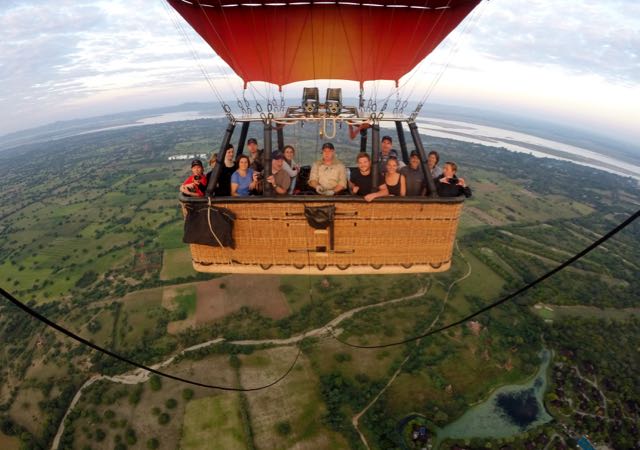
The hot air balloon ride was phenomenal. There are some experiences for which it’s just worth paying the money. Trekking with gorillas in Rwanda was one, flying over the Nazca Lines in Peru was another, and this was definitely a third. Understandably, it’s an almost military operation, with 21 balloons between the three companies all being prepared for take-off from the same area at the same time. Battalions of minibuses collect the punters from a 7-km radius, depositing each busload to the correct campsite where hot coffee and shortbread is on hand (I was afraid, when I saw yet another busload join our group, that, in having a second cup of coffee, I might have dented their rations, but clearly serious caffeine needs are anticipated). Safety briefings are given by each pilot to their balloon-load, and then the acres of lifeless silk are slowly inflated by massive fans, each balloon remaining tethered to a nearby minibus. Everyone on the team of a dozen or so per balloon knows their role to the last inch. Ropes are tugged, silk coaxed, and even the inside of the inflating balloon is checked to ensure all is in order there. At a certain point the burners flare, and we feel an unspoken competitiveness with the other balloons: is ours going to be first? Which one’s lagging behind? Once the balloon is vertical and the signal is given, we clamber aboard. Final checks go on between pilot and ground crew with much radio liaison, and then suddenly we’re waving to the ground crew. Jokingly (we hope), the crew call “See you tomorrow”, when, in fact, they are each going to be keeping in close contact with our pilot to coordinate the minibus and tractor getting to the right landing zone. Ours was a day of “light and variable winds” and I gather our crew had their work cut out for them as Chris-from-southwest-London (most of the pilots are British), told them first one site, then a second, and then a third.
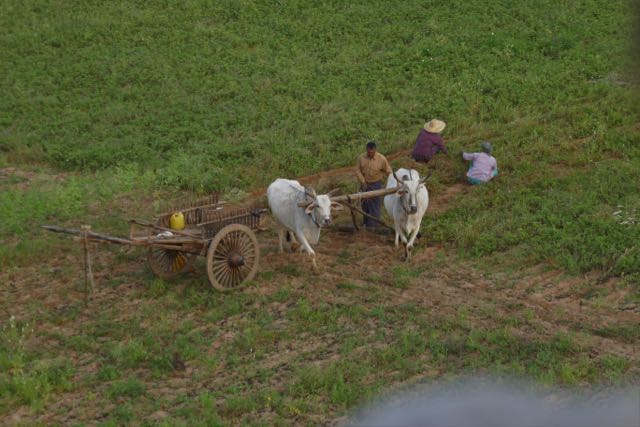
Eventual beneficiaries of tourist largesse, perhaps?

By the time we took off, the sun was just at the horizon. We’d all gone prepared with extra layers, but the heat from the burners, although they were only sporadically fired, was enough to keep us warm. The views were simply magical. When the burners weren’t roaring and the chatty Germans in the far end of the basket drew breath (our basket had five sections, the middle one being Chris’s “office”, with each of the other sections able to accommodate up to four people, although we were only 14 passengers in total), it was wonderfully tranquil. Somewhat randomly, as it seemed to us, Chris took the balloon up and down, searching for the most helpful wind on this slightly challenging day. At one point, I thought we were going to scrape the top of the palm trees. At other times, we had an endless view across the Irrawaddy to the north and west, and over to the extinct volcano behind Mount Popa, Taung Ma-gyi or Mother Mountain, to the south. But then we flew over a farmer leading his oxen and plough, a couple of women hunkered down on their haunches working in the field beside him, and I suddenly felt sickened. In this, one of the poorest countries in Asia, I had paid what was likely the best part of their annual income for a two-hour experience. I could only rationalise it on the basis that, overall, tourism is essential to the area, bringing in much-needed income that flows down through all levels, even to our farmer in the fields as he sells his crops to nearby restaurants. But it was still an uncomfortable realisation.
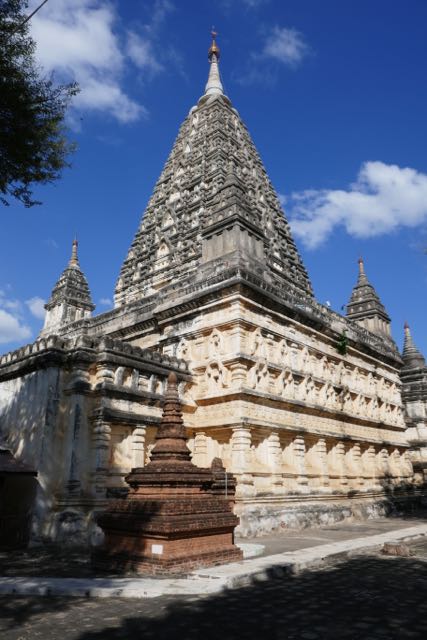
Mahabodhi Paya, Bagan

Back on the ground and after a suitable snooze to recover from the painfully early start, I bit the bullet on the e-bike experience. Once I’d got going, I found it a lovely way to travel. Almost silent, yet reasonably speedy. But starting and stopping remained challenging, even after a second half-day on board the next day. These small technicalities to one side, it was the perfect way to travel around to fill in the temple gaps, taking me to Old Bagan (where I wimped out and parked the bike by the city gates, electing to go around temples on foot) and further afield to the Myinkaba and New Bagan temples. My last stop was Mahabodhi Paya, modelled on its namesake in India which commemorates the spot where the Buddha attained enlightenment. I’m not sure I’d attained much beyond a couple of hundred photographs, a scraped calf and a bruised hip, but I was happy, and, after returning my steed to its stable, went off to commemorate my achievements with a large cold beer at the delightful social enterprise restaurant, Sonan.

A touch overgrown: some of the 90,000 Buddha images of Kothaung Paya, Mrauk U

Slightly less than two days’ later, I set out again, on foot this time, to explore the temples of Mrauk U. Here the landscape is hilly, and practically every lump of ground is crowned by a stupa of some description. The dark grey stone and imposing designs make the temples here impressive rather than picturesque, but their immediacy, their lack of tourist paraphernalia appealed to me enormously. On my second day, when I was exploring temples further afield, I frequently found myself on my own, not even a farmer in a nearby paddy-field or gang of kids tagging along. The audio backdrop was pure nature, timeless. It may have been a tad on the warm side – 32C with xx% humidity, “feels like 38C” my phone kindly informed me – but I was relishing every minute of it…
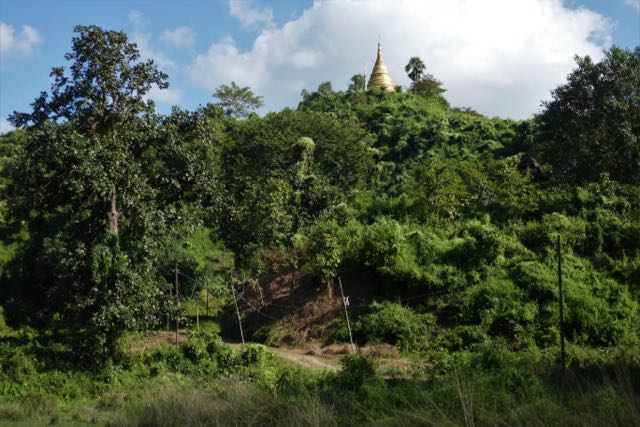
Shwetaung Paya, Mrauk U

…until I got to the Shwetaung Paya. I guess I should have believed the Book when it said “it’s accessed by a few trails largely lost under thick vegetation”. That’s putting it mildly. The uncharacteristically golden stupa was clearly visible at the top of the hill, so I stopped to ask a monk who was pottering outside what was clearly “lower” Shwetaung Paya the way up. He pointed vaguely behind a grazing almost-albino gelding, and sure enough, there was the bottom of the track. Which was about as visible as it ever got. Not to be deterred, I scrambled upwards, looking each time for the least thick growth through which to plough my way. I came across a second track that approached from the other side of the ridge, so made a note to myself: look for the yellow flower (which I’d just passed), and ignore the red (which I could see in front of me). Woe betide me if a flower-picking supplicant appeared while I was up top. At one point, I had to scramble up a slope, grabbing onto whatever branch or undergrowth didn’t immediately give way. And yet the Paya gleamed above me, daring me to make it the whole way up. More by luck than judgment, I popped out at the foot of overgrown stone steps to be greeted by a pair of chinthe, the Burmese lion-like creatures that often guard temple entrances. I swore some very un-Buddhist things at them, and the golden stupa beyond. But the views were fabulous, and after half a bottle of MAX, Myanmar’s answer to Fanta, I was prepared to enjoy them; they had been worth the climb. Yet, cautious of the perils of gravity on the unwary, I messaged two of my siblings to let them know where I was and what to do if they didn’t hear from me after a certain period of time. Extraordinary as it was, even here, in the back of the back of beyond, I had a good mobile signal. The travel gods were with me, however, and I made it safely back down the hill with only a few scratches.

After so much of the other-worldly, it was time to return to somewhat more prosaic considerations: getting back to Yangon and thence to Singapore for the weekend. Myanmar only allows tourists 28 days on their visas, and I would need a new one if I were to continue my adventures in the south.
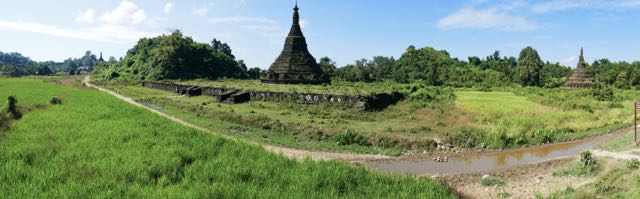
Laungbanpyauk Paya and neighbours from Amyint Taung, Mrauk U

Getting from A to B in Myanmar

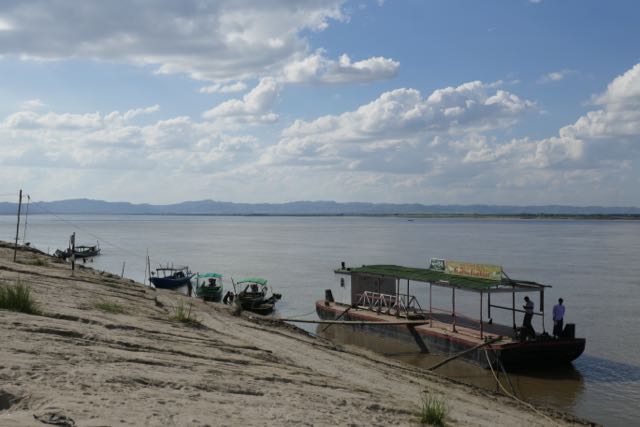
The Irrawaddy at Nyaung U, Bagan

In a little text box in the Bagan chapter of the new edition of the Book, it proudly proclaimed: “A new overland service connects Bagan with Mrauk U…” This was enough to hook me when I was planning this trip. Otherwise, getting between Myanmar’s two most famous archaeological sites involves two planes and a boat, none of which connect, which means a minimum of three days’ travelling. It’s only 479 km, but, as I had quickly learned on arriving here, the number of kilometres has no bearing on the time involved. Historically, the bus option necessitated backtracking almost to Mandalay, I believe, which, on the basis of what has been my last 24 hours’ experience would be, err, suboptimal. And so, my first afternoon in Nyaung U, the transport hub for the Bagan area, I tootled off to talk to the Ever Sky travel agents recommended by aforementioned tome.

Thatbyinnyu Pahto from Natlaung Kyaung, Bagan

A ridiculously short time later, I was the poorer by $30 but happily bearing a ticket that promised to pick me up from my guest house “Around 6:30 PM” for the 7 pm “Modern [the name of the bus company] Bus from Bagan to Mrauk-U” four days’ later. “Seat No.17” was expecting me. The travel agent told me I’d be going by bus to Kyaukpadraung, about an hour down the road, where I would change onto the Mrauk U bus, but the driver would change with me there so I didn’t need to worry. I was to discover that some of this might have been slightly adjusted in translation.

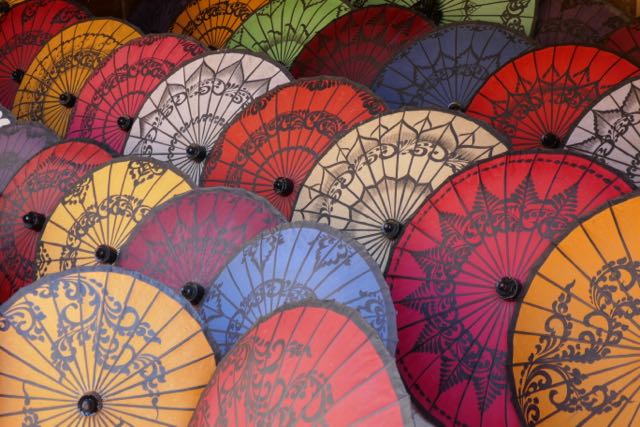
Parasol stall, Bagan

“Around 6 pm” (because I’m a closet boy scout this respect), I was showered and waiting in the reception area of the lovely Saw Nyein San Guest House, where I’d been staying all week, and trying not to look at my watch every half minute. I was conscious that my hostess had looked a little put out that I hadn’t engaged her auspices to acquire the ticket, so I wasn’t exactly sure what my Plan B would be, but there was no need. At 6.40 pm, a minivan drew up and a young man came in. “Mrauk U?” he asked. (It’s pronounced “miao-oo”, the Burmese having a bit of a dislike for consonants, I was beginning to conclude.) I leapt up, and he took my bag while I thanked my hostess effusively for all her and her family’s hospitality. Outside, a second man showed me into the front passenger seat, while my bag took up lone residence in the boot, and I found myself the sole paying customer on what seemed to be a family outing. The three-and-a-half year old and I exchanged my sum total of Burmese and, prompted by his father, his sum total of English, while baby sister squawked occasionally and Mum made comforting sounds.

South of the Nyaung U bus station, we stopped for fuel. “OK,” I thought, “they must be taking me the whole way to Kyaukpadraung. Nice. Time to get comfortable and relax.”

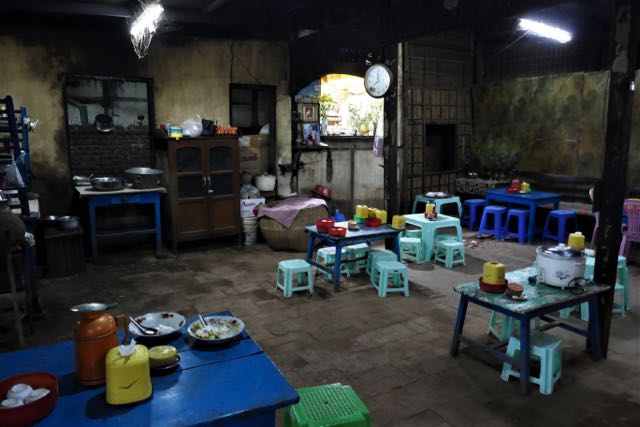
My home for several hours, Kyaukpadraung

About forty minutes later, we stopped at one in a row of the large open-air shops-cum-cafés that are so common here. But a bus station, it wasn’t. Confused of South-East London. My bag was extracted from the boot, and the father kindly came to open my door, as if assuming that my lack of effort in this regard was because I was awaiting his attentions. “You wait here,” he told me, while my bag took up residence in the indoor part of the café. “Bus come. Half an hour. Less,” he assured me. “Err, really?” The doubt must have been writ huge across my face. “Um, OK then. Jezu-ba,” I thanked him. The family headed off, and I went to join my bag. Now what?

To my relief, a couple of buses pulled up only about twenty minutes later. Result! I picked up my stuff, and scampered to the front of the café. “Mrauk U?” I asked a couple of likely candidates. “No, no, no. Wrong direction. Don’t worry. We get you,” a young man from the café assured me. I wasn’t convinced, and went back to my plastic stool.

Nandamannya Pahto, Bagan

The first bus to arrive from the opposite direction had, of course, exactly the same effect. I grabbed my bags, scampered to the front of the café, and posed my now usual question. One man shook his head at me blankly, dismissively. Uncomprehending, uninterested in comprehending. It was a rare – possibly the first – instance of rudeness I’ve encountered here, and I shrank back, bemused. But I was rescued by the lady of the house. There’s something about Burmese women running hospitality businesses, I thought, generalising wildly on the basis of two. Fearsomely efficient, their menfolk and assorted other relatives scuttle meekly in their shadows. My Nyaung U hostess was of that ilk. Diminutive, but with a particularly staccato way of speaking English, she packed a verbal punch. And here was another. “You wait. Don’t worry. We get you. Don’t worry. May be one hour. Or more,” said my new best friend, smiling at me.

Tubby Buddha, Shwezigon Paya, Nyaung U

So now I knew the score. Back I went to my plastic stool, out came the diary, and on went the business of the café. New Best Friend returned to her accounts, and the two teenage girls helping out continued their conversation, smartphones glued to their hands. Something prompted a comment from New Best Friend, to which one of the girls replied a touch petulantly. I laughed out loud. “Daughter,” said New Best Friend, catching my eye, and gesturing to Petulance. She didn’t need to tell me: the dynamics of mother-and-daughter are oddly similar the world over. The little lad busied himself with chopping apples into plastic bags for the next set of tired and hungry passengers, he wielding a large and evidently sharp knife with careless efficiency. Later, he helped out with the accounts, shuffling notes in his roll of cash as if he’d been doing it since he was born. He can’t have been more than ten, but with all his mother’s efficiency and self-reliance. Behind me, the twin altars of modern Burmese society: a television showing a soap opera, all bad acting, soft lighting and long looks, and the family shrine, bedecked with fresh flowers. Every so often, another bus or two would turn up, and disgorge its contents who’d make their sleepy way to the toilets at the back of the café, and then return, brighter, seeking further sustenance.

And so the evening wore on. New Best Friend had disappeared by this stage, and I made one more effort to find my own bus, but was rescued by Petulance, tearing herself away from the soap opera to save the firanghi from an erroneous destination.

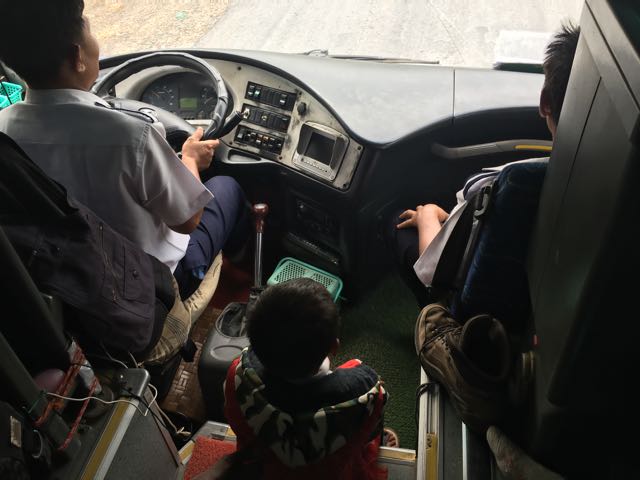
Trainee bus driver

Finally, the call went out. A bus – not branded “Modern” at all – had pulled up a little past the café on the far side of the road, and New Best Friend reappeared. From the looks of it, she’d been out there for the previous half hour or so, waiting to accost the bus lest it try to zip past without picking me up. I was completely indebted to her. Efficiently, she took my ticket and went to discuss it with the driver, while my holdall was taken in the opposite direction by the driver’s assistant. How to keep an eye on two directions at once: I was left marooned in the middle, looking to each side of me in turn like a pigeon watching Wimbledon. Even my small holdall wasn’t going to fit in the bus’s luggage compartments, clearly. From what I could see of the inside of one, there wouldn’t have been room for a bookmark. The assistant took my bag on board, while I caught up with New Best Friend. “Four,” she held up the requisite number of fingers and gave me back my ticket. At the third repetition, I figured out her meaning. Clearly “Seat No.17” had gotten fed up waiting for me, although, on reflection, I wondered if the change in seat was deliberate on the part of the driver. Seat no.4 was right behind the second driver and assistant. Only a couple of hours along the road and I found myself being accosted by the assistant. “Passport!” And this was to happen on three more occasions, only one of which also involved the Burmese showing their papers. It’s easier to keep the firanghi close by if she triggers regular extra paperwork. Oddly, I never needed to show my face. It was enough that my passport could adopt a pair of legs and walk over to the roadblock or police checkpoint by itself.

One of the more interesting river crossings

My seat-partner redefined taciturn. He was a small lithe man who kept himself to himself and, if my settling in and sporadic wriggling annoyed him, he was too polite to say anything. Me, I was struggling with how to get comfortable and maintain Burmese propriety. Can you breach local etiquette if no-one sees you? Never mind my seat-partner, there were two monks on the other side of the aisle. I became paranoid about which way the undersides of my feet were pointing, but the bus was dark for the most part, and I finally pushed this consideration into second place. After all, sitting so close to the front has one major night-time disadvantage: there’s no getting away from all oncoming traffic’s high-beamed headlights, never mind the driver’s prolific use of the horn (though I subsequently noticed that it was largely aimed at avoiding the local canine population, so forgave him every tuneless toot-a-thon). I wondered if it was going to be possible to get any sleep, and found myself noticing the bus’s red-illuminated clock far too often for what was, by any measure, going to be a long night. I dug out my iPod. Remember those? The battery lasts way longer than an iPhone’s… On went my stalwart lull-me-to-sleep-on-transport choice, Pink Floyd’s “The Division Bell” and, before I knew it, the clock had jumped on half an hour all by itself. There was hope for this night yet.

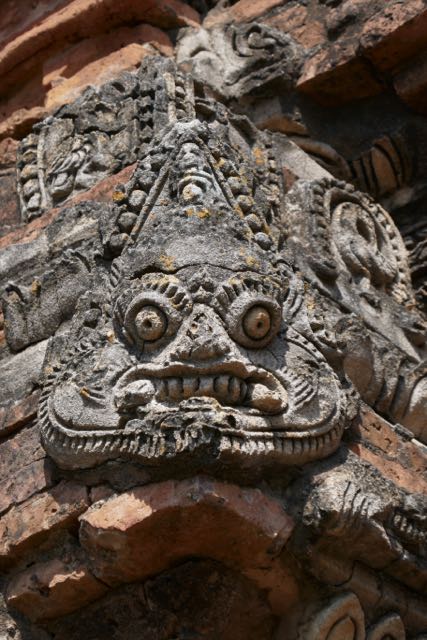
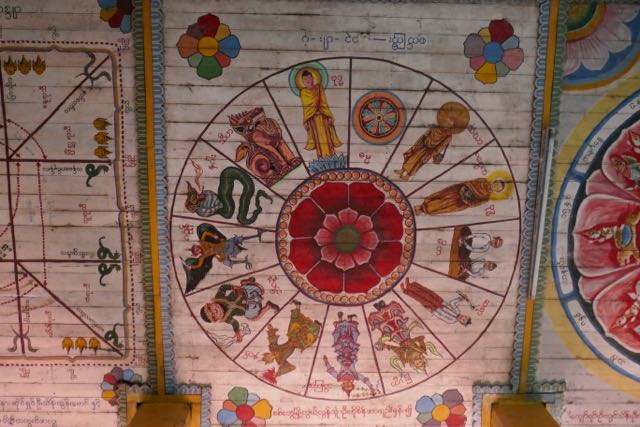
Ceiling detail at Shittaung Paya, Mrauk U

At 1.45 am we stopped for toilets, refreshments and a change of driver, though First Driver stayed with us and would continue to alternate with his colleague. EU long-distance driving and rest regulations all too evidently don’t apply here. When it looked as if everyone was refreshed in both directions, as it were, Second Driver tooted the horn, and First Driver kindly made sure I knew what this meant, the combination jolting me out of my glaikit reverie.

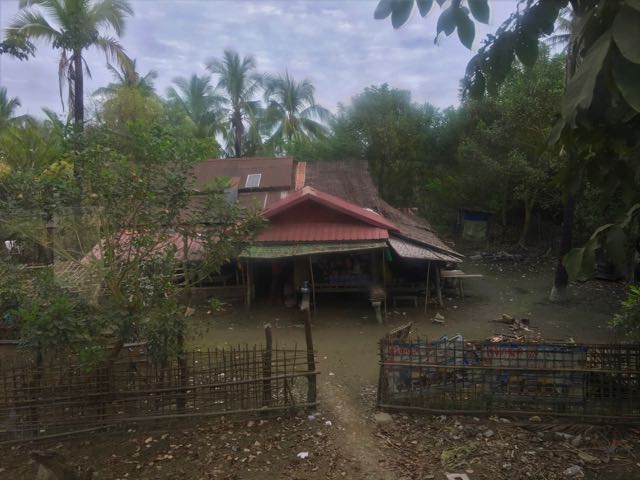
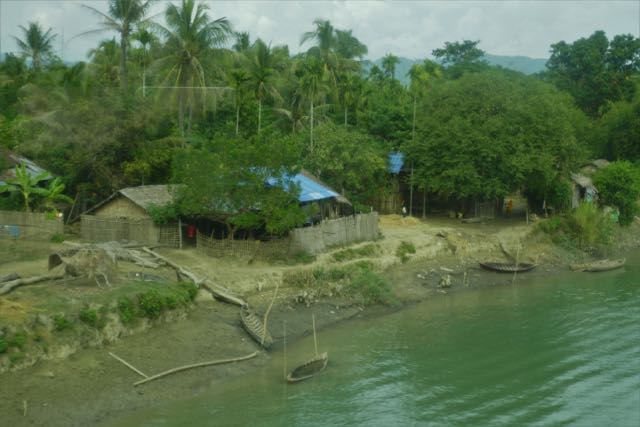
Village in Rakhine state

At this point, we left the Irrawaddy river plain, and started the climb into the hills that separate Magwe state from Rakhine state. (The joys of the impressive mobile phone coverage here: I could keep an eye on our progress, both geographically and time-wise, with the help of Google Maps, although I made sure to add at least 50% to whatever time estimate Google was giving for the remainder of the journey, and even that was to prove to be an underestimate.) Second Driver took it cautiously, with plentiful use of the horn, this time to warn downhill traffic of our imminent appearance, and I lost count of the number of times I opened my eyes to find I was looking at yet another mud bank as Second Driver wiggled our way around yet another hairpin bend.

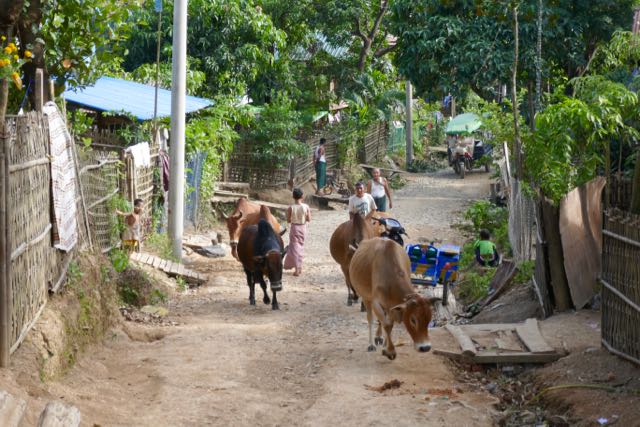
Mrauk U street

For some reason, we stopped again at about 4 am, this time for an hour or so, while the assistant tinkered with something. As the engine (and therefore the air conditioning) was left running, I’m assuming it was bodywork related, and the assistant’s pristine white shirt was a good deal less pristine by the time he got back onto the bus.

Eventually I became aware, on my sporadic eye-openings, that it was getting light outside. Sharp ridges of hills rippled away on either side of me. But my neighbour was keeping the curtain closed, and my eyes were more interested in their lids than our surroundings, so I dozed off again. Since the bodywork stop, we’d been treated to Burmese music, I think from First Driver’s own mobile; it certainly wasn’t bus-wide, but it was enough for me not to challenge Marillion, who’d now succeeded Pink Floyd after a blast of way-too-lively Tom Petty, so I’d turned my own music off.

A rare sign of recycling

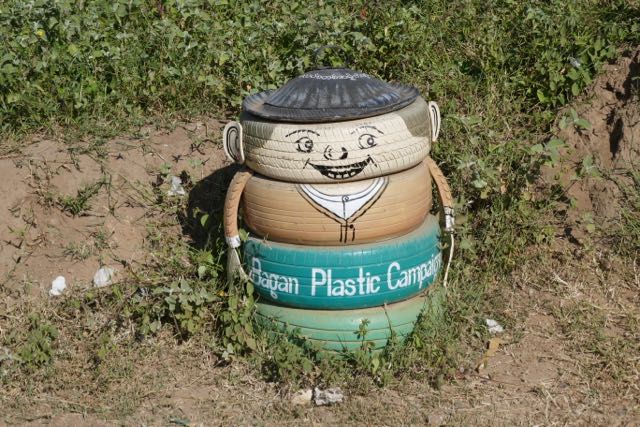
At the everyone’s-papers-check well into Rakhine state, we heaved ourselves off the bus to stretch muscles and in search of toilets, but, shortly after we’d piled back on, we were treated to a breakfast stop. “Showtime,” said First Driver, somewhat unexpectedly, turning towards me to show off his English. This café was a definite grade up from New Best Friend’s. It was a cavern of a place, almost all indoor, with a double-height ceiling and a balcony around three sides. As we’d exited the bus, we’d been given the thoughtful gifts of a wet towel and a toothbrush/paste kit. Most people beetled off to use both, but another female passenger and I elected to have a quieter wipe-up while waiting for our breakfast, and for teeth to be done afterwards. When I did go out back later, I was embarrassed at my fellow passengers’ (and no doubt several days’ worth of passengers’) behaviour. Toothpaste tubes and plastic wrappers littered the ground beyond the water tank, despite a crate being provided for litter. But sadly Myanmar, like most countries, is only coming late to the recognition of the evils of litter and the possibilities for recycling. (I had seen a couple of plastic bottle receptacles around Old Bagan, but sceptically wondered if the bottles then went anywhere, other than the general landfill.)

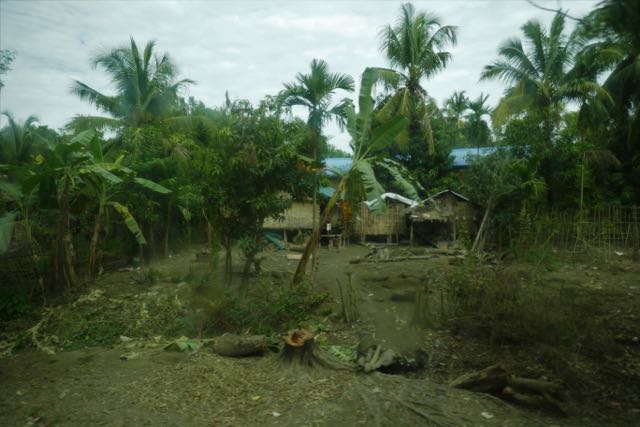
Village in Rakhine state

In the meantime, I thanked, for the nth time on my travels, the fortuity that “coffee” is one of those internationally recognised words. The young girl serving nodded, and reappeared seconds later with a mug of hot water and the now-inevitable sachet. Coffee is not something Myanmar does, I’m finding. I kicked myself yesterday afternoon when, for my final meal in the Bagan area, I was given the best cup of coffee in the country so far – WHY hadn’t I known this fact about this particular restaurant before then? Coffee at hotel buffets has tended to be filter, but sometimes pretty weak. Coffee when you’re out-and-about can mean a cold can of, effectively, coffee milkshake – and very fine it is too, particularly when you’re a little hungry but aren’t feeling confident about the street food on offer. Otherwise, “hot coffee” means exactly what I was now being given. At the end of the day, it’s hot and wet and reasonably coffee-flavoured, and fools my digestion into thinking it’s had the day’s caffeine intake, and that’s what matters. (Maybe the British should have let the French extend their influence over Indochina into Burma after all – you get great coffee in Laos and Cambodia.) And here I was also presented with a basket of pre-wrapped bakeries. Who’d have thought that my first meal in Rakhine state would have involved marmalade? Yes, my plastic-wrapped e-number-laden white roll – no doubt manufactured back in the ’90s, but still tasting remarkably fresh – contained what tasted suspiciously like the good ol’ British breakfast staple.

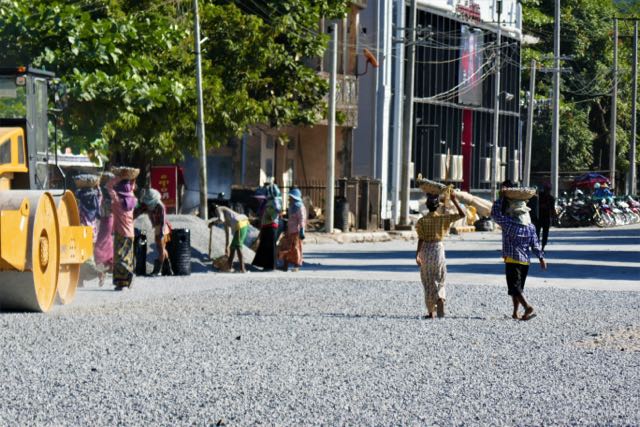
Road mending team at work, Mawmalyine

And so our journey continued. The roads had been much worse since we left the plains, and now the horn was being used to warn roadworkers of our approach. The majority were women, in the kind of flat/conical straw hats that I used to associate with the Vietnamese in rice paddies, but which are so prevalent here too. Here the women were loading baskets with sharp-edged gravel to fill holes in the road. The man driving the grader was wearing a mask against the dust. The women weren’t even wearing gloves.

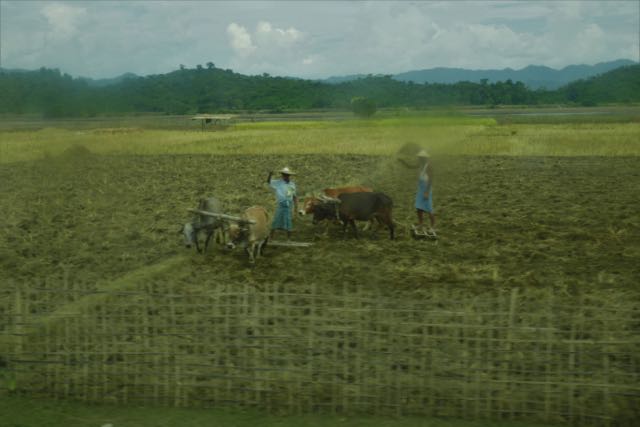
Working the fields

When we dipped back into flat country, the fields were peppered with people and animals working on the rice, and I realised I hadn’t seen a tractor on the land since I’d arrived in Myanmar. Everyone has a role: kids tend the goats, men work the oxen, everyone helps in the fields, and those back home lay out the rice and monkey nuts for drying. Here the rice paddies were almost luminous in colour, the plants at that just-about-to-bend-over stage, but brilliantly green right now.

Yet another river crossing

The bus assistant had dispensed small black plastic bags to the paan chewers, though I was relieved not to hear any hawking from my fellow passengers. My neighbour discretely hid his head behind the curtain to spit. Younger Monk decided to use his water bottle instead. Somehow smoking (which I’d seen him doing at a couple of stops) or taking paan, which both monks did, didn’t seem very monk-ly. I find myself more and more sickened by the habit here, having noticed a bit of a reduction when I was last in India. At Kyaukpadraung the previous evening, I’d seen a woman paan addict, her mouth looking dark and menacing, despite its smile; positively vampire-like. I was told by my Shwedagon guide that it causes gum cancer – that’s why, he said a touch piously, he didn’t indulge. What about the fact it looks awful? Hideous red gums and gappy teeth.
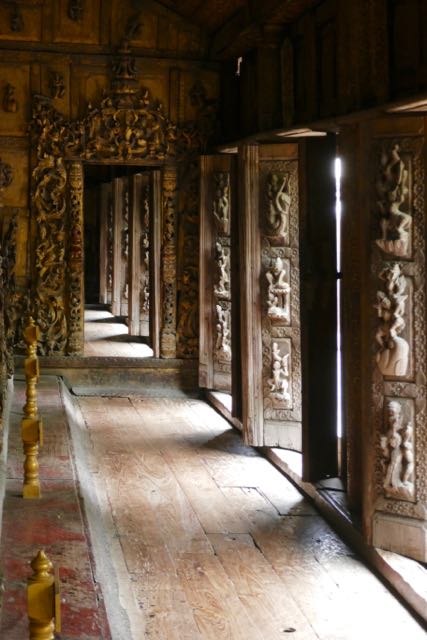
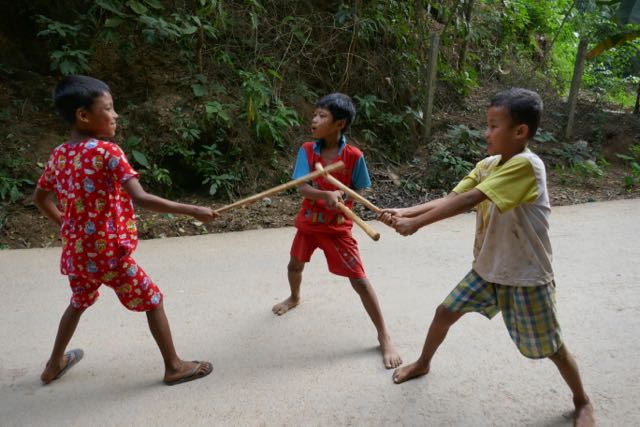
Kids, the same the world over

Slowly, slowly we made progress. We reached our first passenger-offloading stop in the early afternoon, a real milestone, I felt. My hope, since we’d come down the inter-state hills to the estuarine plain, that it would all be flat country from now on, had long since evaporated. Odd little hill ranges would pop up, and without warning, the quality of the road on the flat would change dramatically. After a mid-morning snooze – what was that the Book had said about our arriving at Mrauk U “at 10am or 11am”? We were still, by my assessment, a good four hours’ off – I woke to find that we were actually on full width, two-way road, as opposed to the largely single-track-with-wide-patches-of-dirt-for-passing version that we’d had since the middle of the night. But that didn’t last long. Through the villages, the road reverted to dirt, and, for the most part, it remained patchily sealed, with large patches of very unsealed. But I’ve been on far worse, and finally we were drawing into Mrauk U. I found myself tracking the route as we drove, remembering it from my scrutiny of the Book and Google Maps. When we stopped, I made to get up, but an older man, with whom I’d been speaking earlier, motioned for me to stay put. I’d worked out that my hotel lay on the bus’s route – it was going on to Sittwe, another 4-5 hours further on, I’d guestimate (which, for those who had started at Mandalay the previous afternoon going to the end of the road, would have meant a humungous endurance test) – and, sure enough, from what I could pick up, he’d essentially told First Driver that the bus was going to go right past my hotel, so please could they drop me there? I was losing track of my fellow travellers’ kindnesses, and this one – absolute door-to-door service – took the biscuit. And all for a bus ticket of $30.

21½ hours from leaving my Nyaung U guesthouse to arriving here.

Boy, that shower, cold beer and bed are going to be welcome. I’ll postpone the temples until the morning. They’ve been here several centuries. I think they can wait another 18 hours.

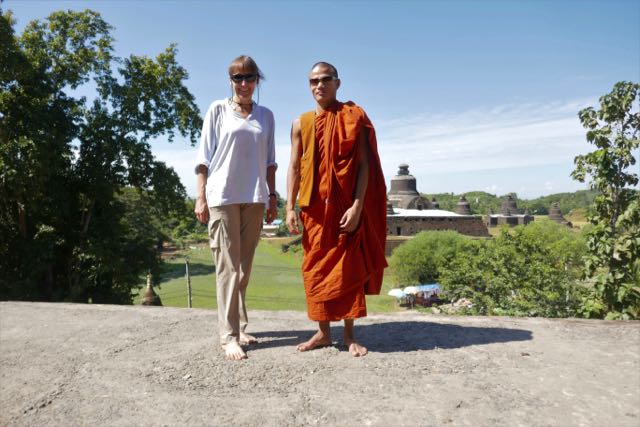
Meeting a monk the next day

Inle Lake – a fragile paradise

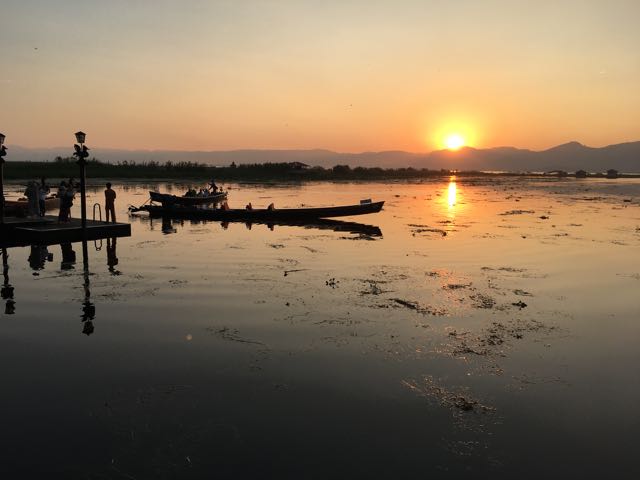
Sunset over Inle Lake

Animal, vegetable and human sustenance apart, I’ve come to the conclusion that water – whether fresh or ocean – in Myanmar has three key roles.

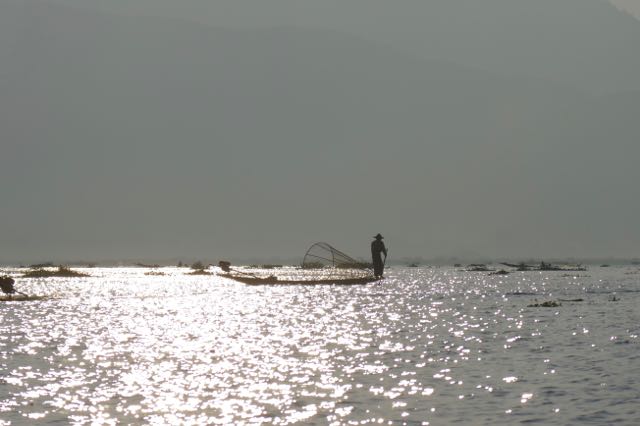
Inle fisherman

With fishing and tourism, it is a way of life, of making money, surviving.

In a country that has what I’ve seen politely described as “erratic” roads, it is a vital conduit for transport.

And here, where over 65% of the population is still rural, it can be a welcome place to relax and have fun.

My watery travels managed to reflect all three roles, but, for the sake of your digestion, I’ll post these as separate blogs.

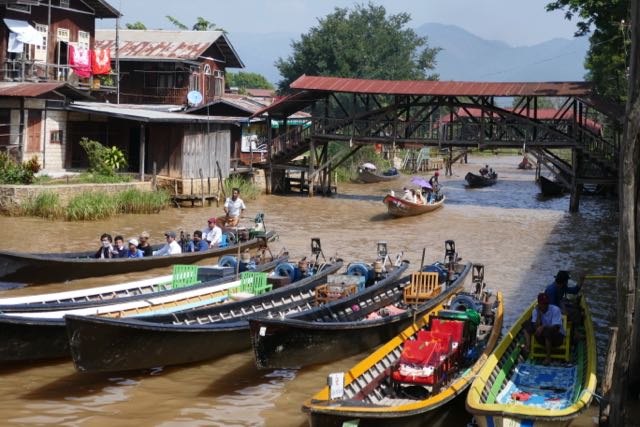
Tourist transport at Phaung Daw Oo Paya

After scampering round the capital-fest that is the Mandalay region and to fortify myself before the temple-a-thon that is Bagan, I opted few days of luxury on the shores of Inle Lake. There’s the option of staying in the nearby town, Ngaungshwe, which straddles a canal system filled with boatmen keen to takes you to the lake, but I decided to push the boat out (no pun intended) and stay on the lake itself. The Inle Resort & Spa kindly provides (slightly) cheaper accommodation in somewhat less aesthetically-appealing but nevertheless very comfortable two-storey whitewashed blocks at the far end of its beautifully landscaped lakeside property, out of sight of the luxurious detached cottages. I had to keep reminding myself where I was. The similarity of the resort to medium-to-high end African safari camps was striking, although here there was no requirement to wait for a member of staff to escort you back to your room given that the primary nocturnal wildlife – judging by the night-time noises – was ranine, interspersed with cicadas.

Classic Inle – boats and temples

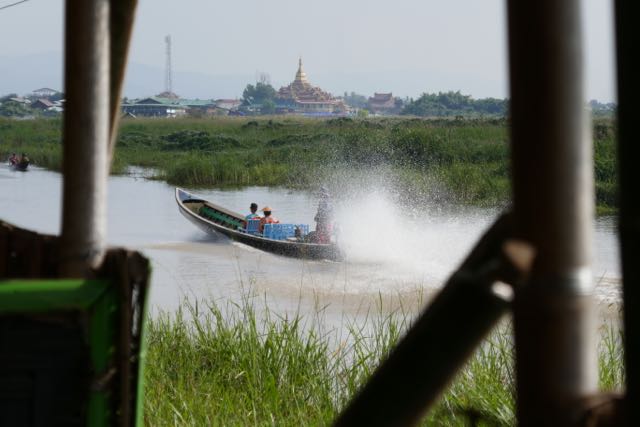
THE thing to do here is to get a boat out onto the lake and go see the sights. So I did, relishing the early start to get ahead of my fellow tourists. To my delight, I had the boat to myself; well, me and a guide and a guy to yank the engine into life. Longtail boats are ubiquitous here, each with an inboard motor which operates a propeller at the end of a long shaft trailing out behind. Getting the engine going seemed to require at least as much technique as I remember my father exercising on his old Seagull outboard in the West Highlands of Scotland: not for the fainthearted. Sadly these engines are very noisy and polluting, but they are the mode of transport of preference for the majority of lake residents. The boats come different sizes, mine being at the smaller end of the spectrum, with space for perhaps four chairs to be set out, one behind the other, along the boat’s length, but we passed heavily laden “bus” variants that were much bigger and infinitely more heavily laden. There wasn’t a safety briefing, but, in wriggling around to get comfortable a few minutes into the trip, I found the lifejacket, a useful cushion in the interim.

Shwe Inn Thein Paya

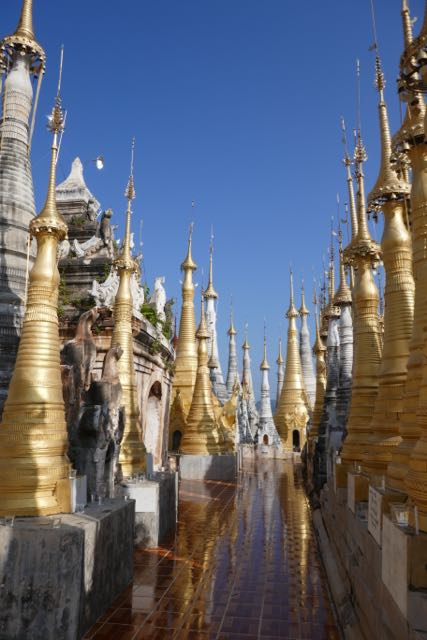
It was a bit of an Alice-in-Wonderland experience. The hotel had advertised where we were supposed to go, but visiting the five-day rotating market depended on where it was that day, and the list that the hotel had provided didn’t entirely line up with the Book’s recommendations (although some of the gaps turned out to be the result of spelling and/or description discrepancies). I came back feeling as if I’d seen a lot of manufacturing and commerce in evidence: silversmiths, blacksmiths, weavers, spinners, cheroot-rollers, boat-makers (“ship-builder” sounds a bit metallic for these patient teak workers), fishermen and gardeners of the impressive floating vegetable gardens, to name but a few. In addition, there were several temples and monasteries, and a place that combined the breeding of Burmese cats with a high-end lodge, a cookery school, and the development and promotion of eco-friendly agricultural and waste-disposal practices. I had the pleasure of exploring Inthein, the extraordinary forest of (so the Book tells me) 1,054 zedis (stupas) staggering up the hill, some choked in vegetation and crumbling in a Angkor Wat-like fashion; others glittering, fresh-scrubbed, in the sunlight, before the other tourists arrived – indeed, before most of the stallholders along its long entranceway had set up shop. But the crowds got their revenge on me when I arrived at Tha Lay. There the press of people, after a couple of hours’ tranquillity on the lake, was disorienting. I’m not thrilled with crowds at the best of times, but usually I have been able to anticipate them. The cause of the stramash was the glittering Phaung Daw Oo Paya, the holiest site in southern Shan State. Here there are five Buddha relics or images – accounts vary – but they are now so covered in gold leaf (which only men are allowed to apply) that, whatever they were originally, they are now formless blobs. And, for those who can’t or won’t brave the crowds to get close to them, there’s the option of buying a photograph of the blobs. But they’re still blobs. I extracted myself from the mélée and went in search of a cold coffee.

Lunchtime view

“Hotel?” asked my guide as we left the last “sight” for the day, Nga Hpe Kyaung, also known as the Jumping Cat Monastery, where sadly there were no cats in evidence, whether jumping through hoops (for tourists’ and bored monks’ entertainment) or otherwise. I’m not a lunch person, but today it was a case of doing anything to lengthen my time out on the lake. Quarter of an hour later I was happily sitting at one of the stilt-raised platforms that comprise the Shwe Yamin Restaurant. We’d passed it earlier and, albeit a tourist-magnet, I was entertained by this little spider’s web of platforms above the lake’s surface, each containing one table and benches around three sides, attached to its neighbours and the restaurant’s kitchen by similarly elevated walkways. I eked out my Shan noodle dish and decadent lunchtime beer as long as I could, before re-joining the boat to be buzzed back to the hotel and another 24 hours of watching lake-life go by.

Floating gardens

Tragically but not surprisingly, there’s another side to life around Inle Lake. One headline proclaims “An environmental catastrophe with government nowhere to be found”. The lake itself has shrunk dramatically over the years, some estimates putting the reduction as high as 50%, the product of reduced rainfall, land being cleared and reclaimed for the multiplying hotels, and the cultivation of the “floating gardens” that become permanent. Fish stocks and biodiversity have been affected by increasing pollution, including the run-off of toxic waste from nearby industry and chemicals from farming, and the introduction of alien species. The local Intha way of life is being preserved to please the tourist’s camera, but the people themselves are struggling to get by. Hardly the first time where the appeal of the tourist dollar has blinded government and business to medium- and long-term environmental and human impact. But in 2015, the lake was added to the UNESCO’s World Network of Biosphere Reserves, the first to be so designated in Myanmar. Let’s hope that the resulting investment and conservation assistance is not too late to save this fabulous place.

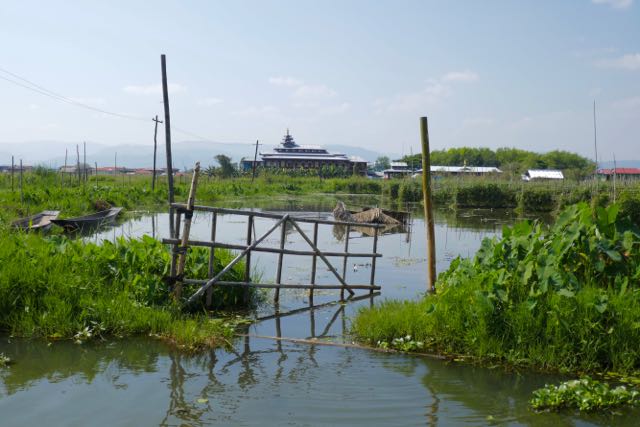
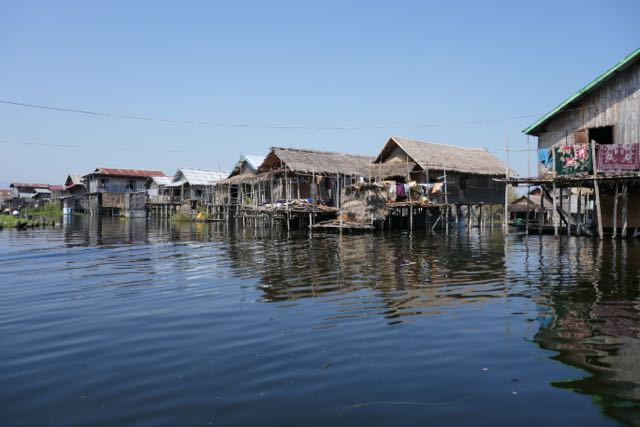
Stilted houses

In and around Mandalay – a confusion of capitals

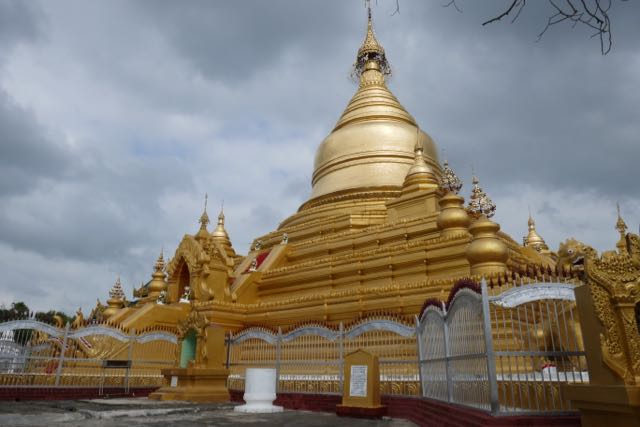
Kuthodaw Paya, Mandalay

Planning a trip to Myanmar was like opening a box of chocolates. Where to start? With so much to see, it’s deliciously daunting, even with advice from a friend who’s been living there a while, though he readily admitted, “If a place is interesting, and has an airport within two hours’ drive, then I’ve probably visited. If it doesn’t, then I haven’t.” Right there is the second challenge: logistics. Roads aren’t great (66 km/41 miles in two hours is reasonable going, I was to discover within the first week), and, despite talk of improvements, the railways don’t appear to have been updated since they were first introduced in the 1870s. (I’ve seen references to the maximum speed being 24 kph/15 mph: they’re not going to rival the Shinkansen any time soon.) Even with the best part of six weeks and a following wind, I wasn’t going to be able to do anything like everything I wanted to, never mind factoring in the possibility that things might not go entirely as planned.

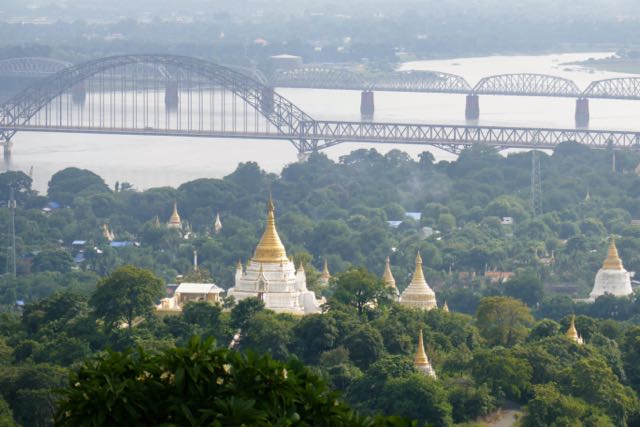
Bridges across the Irrawaddy, Sagaing to Mandalay

Mandalay was always going to be included, however, and it was my first stop after an acclimatising and sociable weekend in Yangon. It’s up there with Timbuktu, Samarkand, and, before I went to either, Bangkok and Peking (definitely this, rather than its current, spelling), for the sheer romance of its name. Yet I went prepared. I knew that the city had been devastated by Japanese air raids and that the Royal Palace had been burnt down as a result of British bombing. I wasn’t expecting much beyond the name, my first proper sight of the Irrawaddy River – another magical name (I’m ignoring the new spelling, Ayeyarwady) – and a convenient base from which to explore the local area.

Stupa ruins near Bagaya Kyaung in the old capital of Ava (Inwa)

It was also my third Burmese capital city in almost as many days. The Bamar monarchy believed in moving its capital on a regular basis, disassembling and moving key buildings from the old capital to the new one in an oddly nomadic fashion. Occasionally, as if running out of ideas, they’d go back to an old locale. The military government of recent times appeared to emulate this practice in the mid-1990s with the formation of Nay Pyi Daw, though indulged in a spate of new building rather than relocating buildings from Rangoon/Yangon. (Nay Pyi Daw was not on my list – “Milton Keynes without the roundabouts,” I was reliably informed.) Within a couple of hours’ drive of Mandalay, I would find myself in four more erstwhile capitals. So prolific are they in the fertile and slightly better climate of the upper Irrawaddy valley, I didn’t even realise that Amarapura – famous for its photogenic long teak bridge, rather than its history – had been a capital until after I got back to the hotel that evening.

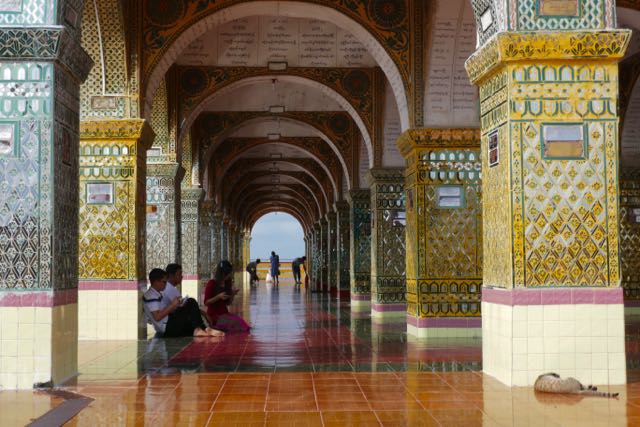
Hanging out in a Mandalay temple

Unusual in only having one name – despite the military’s spate of history-denying renaming in the late 1980s, many town and city names, like the country’s own name, continue to be used in both the old and new forms apparently interchangeably – Mandalay has remained Mandalay throughout. The centrepiece is still the old Palace, its moat-encircled red walls stretching an imposing couple of kilometres on each of its perfectly created four sides. While not quite being on a par with Beirut’s Corniche, the moat-side of the surrounding roads, being wide and tree-sheltered, is clearly popular with those “taking the air”, as well as running and exercising, using its intermittent collections of outdoor gym equipment with greater and lesser levels of expertise, though I’m not sure a longyi – the ubiquitous long skirt-like garb worn by men and women alike (but differently folded) – is necessarily the best workout clothing.

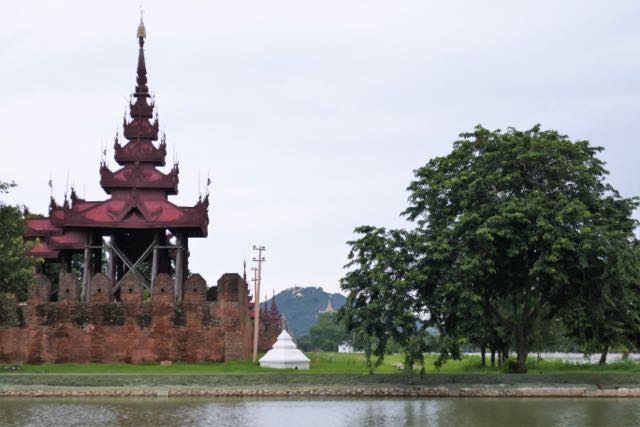
Mandalay Palace walls and Mandalay Hill

At the southeast corner, I was greeted with my first sight of Mandalay Hill, perfectly in line with the eastern Palace wall’s moat, and, from this angle, a perfect cone dotted with golden zedis (as stupas are known here). The next day I climbed its 1,729 steps (or so the Book tells me – I confess, I didn’t count). While this may sound a little daunting, the route is well broken up with un-stepped pathways and distractions, leading through so many shrines that shoes have to be left at the foot of the hill. What I wasn’t prepared for was the number of puppies. Stray dogs are prolific in Myanmar, but, somehow, they go in for having their puppies on Mandalay Hill. I swear, if that really cute one I fell in love with on the way up the hill had been in evidence on the way back down, I’d have been very hard pushed not to have the small fellow in my luggage right now. (Note to self: tell my nephew and niece not to come here. Jo had to be convinced not to send home every stray creature we found on our Central and South American peregrinations, whether feline, canine, simian or avian… and then there was the junior alpaca she met… A tale for another time.)

Shwe In Bin Kyaung, Mandalay

I was already clocking up a reasonable number of Burmese temples and beginning to get a flavour of the local form of Theravada Buddhism. I was conscious that the first week or so would only be a warm-up for the literally thousands of religious buildings waiting for me in Bagan, so tried not to overdo it. Glitz and gold are big here, dramatic at a distance but a touch overpowering up close after the first few. While many religious buildings are whitewashed stone or brick, there are a few surviving constructed out of teak, and this iconic old hardwood is a welcome contrast from the glitz. But there’s a nice harnessing of the modern to assist in bringing out the traditional: the Buddha’s aura is often illustrated with electric light, concentric circles of differently coloured cables of twinkling light that flash on and off in turn and/or at random. Occasionally, the aura’s rays are electrified instead, also in different colours and flashing. Sometimes women are forbidden from approaching the shrine itself: “Ladies Are Prohibited”, nice and straightforward, but this only applies at the last rail before the statue and offerings, so it doesn’t feel like too much of an exclusion. Shoes must be removed at the entrance to the temple grounds, an earlier point than anywhere else I’ve visited. Sometimes you are offered a plastic bag in which to carry your shoes; at other times you are forbidden from even carrying them into the temple; sometimes there’s a charge for leaving them in the care of someone; most of the time you just cross your fingers that they’ll be there when you come back. (Touching lots of wood, I’ve never had a problem… yet.) And it’s certainly not worth arguing the point – the English objections to this custom in the nineteenth century arguably contributed to one of that century’s three Anglo-Burmese wars.

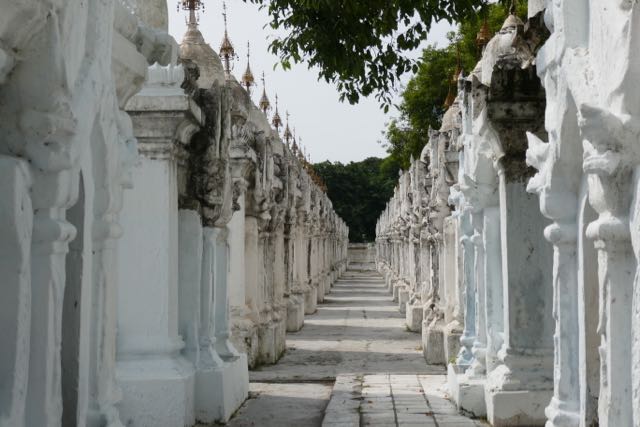
Housing the world’s largest book – a page per zedi

Zedis often contain relics, but there are times when they are so prolific that I struggled to see their purpose. I’ve seen less crowded graveyards. Mandalay has a lovely couple of shrines – Sandamuni Paya and Kuthodaw Paya – where the surrounding zedis have been built in regimented lines and each, open-sided, contains a text-inscribed marble slab. This is reputedly the world’s largest book, the entirety of the Buddhist scriptures, the Tripitaka, engraved on over 2,500 slabs at the behest of the last Burmese king, Thebaw, who, by all accounts, would have been much happier remaining in his monastery rather being chosen to inherit the throne by a cabal of government officials and a scheming minor queen (though not his own mother) out of the 48 sons of the dying King Midon.

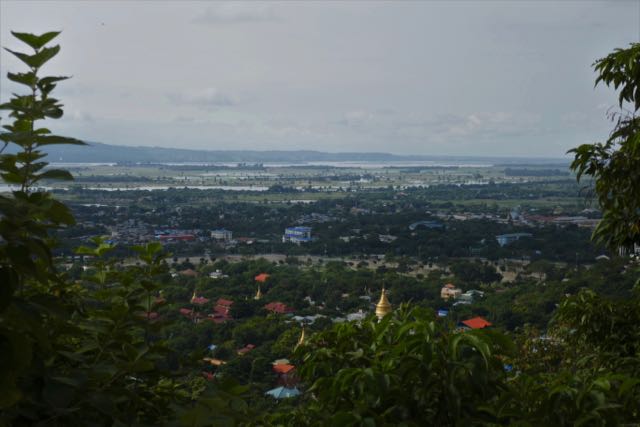
View from the top

Sadly, the view from the top of Mandalay Hill wasn’t too impressive. The week that I was there the valley was still and overcast for most of each day. Even when the sun did make more of an effort, the haze didn’t entirely clear, so when I escaped the valley for the hills later in the week the sight of clear blue sky was most welcome.

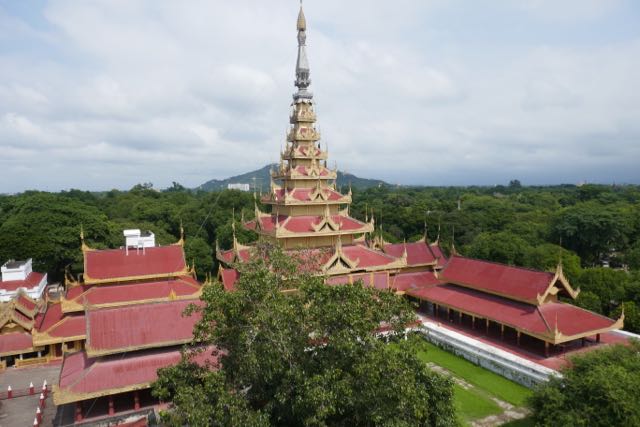
A sterile recreation, Mandalay Palace

Mandalay Palace was rebuilt in the 1990s with the use, allegedly, of forced labour. The Palace, though numbering about 40 buildings, is only a small part of the walled compound, the vast majority of which is off-limits to foreigners as it is still used by the military, a practice started by the British after they ousted Thebaw and his family, and continued by the Japanese during their occupation. I was rather taken aback to be greeted at the foreigners’ entrance gate with banner high on the Palace wall reading, “TATMADAW [the army] AND THE PEOPLE COOPERATE AND CRUSH ALL THOSE HARMING THE UNION”. (It’s not the place of this blog to make any political comment, so I’ll leave this one with you.) It’s odd to walk around the Palace, knowing that it is no more than a recreation of what was here before and, beyond the seven-tiered throne room, the effort seems half-hearted and the entire place feels forlorn. In my mind, I was trying to recreate an early scene in Amitav Ghosh’s wonderful “The Glass Palace” where the hero, little Rajkumar, joins the townspeople in running into the Palace immediately after the British victory to see what they can loot, but comes face-to-face with the fearsome yet impotent and pregnant Queen Supayalat. This general event happened – the townspeople overcoming their fear of the monarchy to satisfy their curiosity in the wake of the British victory, with the King and Queen then being whisked out of the Palace with their children in the back of ox carts on the first stage of their journey to what was to be exile in India – but I just couldn’t see it. The impersonality of the reconstruction, the overgrown paths outside, the lack of information about the various buildings: it seemed dead, fake, pointless.

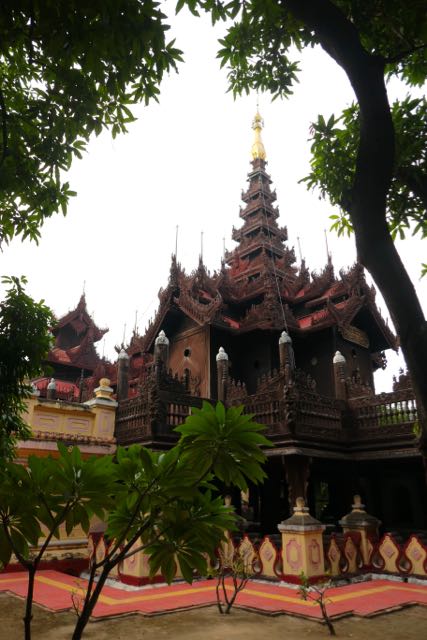
Shwenandaw Kyaung

The contrast between this and the fabulous old teak originality of Shwenandaw Kyaung, the monastery that was next on my list that day, could not have been greater. Oddly, it had started life inside the Palace walls but, as it was reputedly the place where King Midon died, King Thebaw, feeling spooked by his father’s ghost, ordered it to be moved outside the Palace walls – and therefore it remained safe from the British bombing raids (and miraculously survived the Japanese onslaught).

Yedanasimi Paya, Inwa

A 45-minute drive down the road and a five-minute river crossing away is an erstwhile capital that had clearly been a popular choice. Inn Wa – or Inwa, also known historically as Ava – the city of gems, was the Burmese royal capital for much of the period from 1364 to the 1840s when Midon moved his capital to Mandalay and began that city’s short-lived role in history. It is picturesquely (and militarily sensibly) located between the Irrawaddy and one of its tributaries, with the remains of its city walls and moat punctuating the north-western corner of this land. Ordinary homes were built of wood, so they have not survived. The result, in common with other former towns and cities here, is a disproportionately concentrated collection of zedis, shrines and monasteries which, while in varying states of decrepitude, are nevertheless evocative and atmospheric. But the Inwa area is still occupied, and the religious monuments of yesteryear are interspersed with the homes and shops and businesses of several villages’ worth of people.

The official form of transport

Wandering round Inwa for half a day was without doubt the highlight of my time in the area. For some reason that I can’t quite fathom, walking is not encouraged. “The” thing to do here is to hire a horse and cart, and there’s no shortage of both as soon as you step off the boat. “Walking not possible. Long way,” I was assured time and again by people who, let’s face it, had a commercial incentive in convincing me of the merits of their argument. Even once I was well on my way, I was invited time and again to board the back of a moped or a cart, whether or not that cart already had punters on board. And it wasn’t just the locals: “Get a horse!” hollered a middle-aged American from the back of his conveyance. Even the book I’m currently reading, Thant Myint-U’s fabulous “The River of Lost Footsteps” talks of how walking is dangerous because of snakes, though this may be a product of when he was writing: most of the roadways are surfaced nowadays, and the profusion of people and noise should put off all but the most audacious reptile. But the distances weren’t that great. I maybe clocked up 10-12 km (6¼-7½ miles) in my perambulations, if my phone is to be believed, and I was hugely rewarded by having the ability to stop when and where I wanted, to talk to locals and interact with kids (for the second time this week, a cute toddler blew me a kiss from the back of her mother’s moped), never mind the chance to visit temples that weren’t on The List, that I almost tripped over, and therefore had luxuriously to myself. When I got back to the boat drop-off/boarding point, I realised also quite how lucky I’d been in what I hadn’t realised was a comparatively early start. I may have crossed to Inwa at about 10.15am – not an early one even by my sleep-loving standards – but I had had the “ferry” to myself. Waiting to return four hours’ later, I saw the long-tailed boat full to the gunwales with maybe 20-25 people, both locals and tourists, bags and baggage. I was half-expecting a goat or hen to appear.

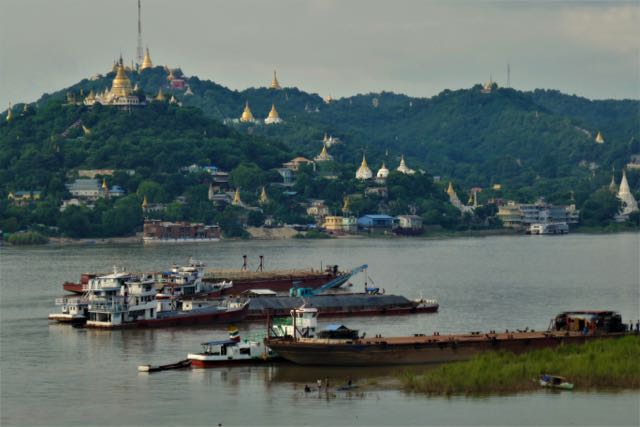
Sagaing from the Mandalay side of the Irrawaddy

Sagaing (pronounced Sa-kai) was another homage to Amitav Ghosh. Without a hint of a plot spoiler, it’s a place that means something to one of the key characters in “The Glass Palace”, and I was intrigued to see its appeal. It claimed capital-city status initially in the fourteenth century, being the precursor in that role to Inwa, but it is better known now as a monastic centre. Its ridge of hills is positively peppered with gold zedis but, being now a little temple-ed out, I limited myself to two on this side of the river, one mega-glitzy and one renowned for its semi-circular colonnade of arches and Buddhas, and one on the Mandalay side, though I have to admit the latter’s appeal was primarily as a viewpoint for Sagaing and the two bridges. The original, the Ava Bridge, was destroyed by the retreating British Army as part of a scorched-earth policy in the face of the Japanese invasion, and not rebuilt until the mid-1950s, when it was for a long time the only bridge across the Irrawaddy. The second one, the Sagaing Bridge, was opened in 2008. In their proximity to each other, I found myself reminded of bridges much closer to home, across Scotland’s Firth of Forth, the newer of which I had yet to cross, yet I’d just been over each of these bridges on the Irrawaddy.
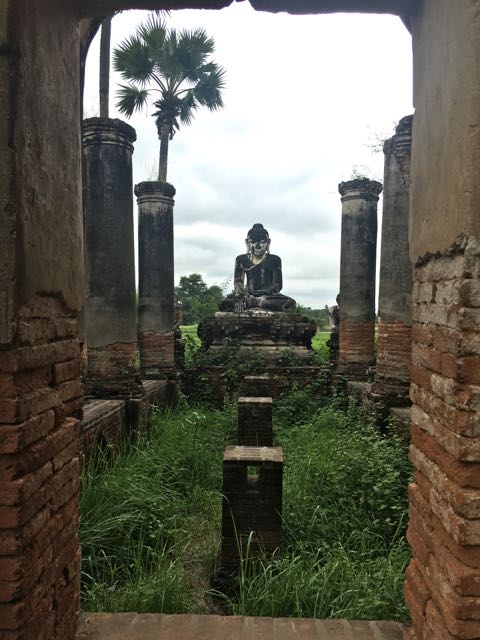
Weaving competition for the Tauzaungdaing Festival at Yangon’s Shwedagon Paya

In an ideal world and with more time, I’d have wanted to take the train northwest of Mandalay, stopping at Pyin Oo Lwin, Hsipaw and Lashio, and crossing the Goktiek Viaduct. When constructed it was, at 318 feet, the second highest railway bridge in the world. As it was, on this trip at least, I had to satisfy myself with a day-trip to the old British summer capital, then called Maymyo, now renamed Pyin Oo Lwin (pronounced “Pyi-oo-lwi”). Myanmar is the land of public holidays – 27 a year, I’m told – and my trip coincided with the two this year to celebrate the Full Moon Day of Tazaugmone. This marks the end of the rainy season, and is the time during which monks are offered alms and new robes. I had already seen alms-gatherers a-plenty on the roads over the last week, usually accompanying a noisy truckload of people partying and blasting out music like a low-cost Mardi Gras float. (I found myself wondering irreverently if some people put money in the bowls to make the noise go away.) One of Pyin Oo Lwin’s temples, the Maha Aung Mye Bon Thar Pagoda, is particularly popular during this festival for the release of hot air balloons lit with candles, an offering to drive away evil spirits. Sure enough, we found the road to the temple already blocked off to traffic, even though we were well ahead of nightfall. Another feature of the festival is the making of new monks’ robes by way of weaving competitions that can last all night, commemorative of the Buddha’s mother staying up all night to weave robes for him. At Yangon’s Shwedagon Paya I’d seen a competition in full clickety-clacking force, and at the Maya Aung Mye Bon the looms were all set up for a competition that evening. The reward sounded extravagant – the joy of having a currency that’s about 1,350 to the dollar – but I felt sure that the successful participant would have earned every last kyat.

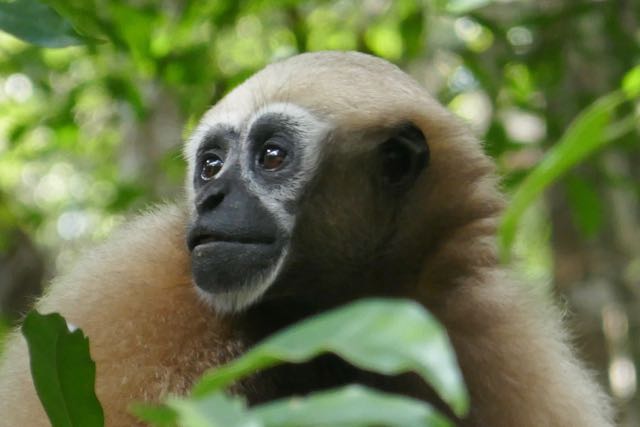
Eastern hoolock gibbon

Earlier that day I’d had a welcome blast of nature and fresh air in the National Kandawagyi Gardens, another hangover from colonial times, now renovated and renamed, and opened by Senior General Than Shwe in 2001. Again, the holiday spirit – quite literally in some cases: the stall outside that sold me a can of iced coffee was selling far more alcoholic options than soft drinks – was very much in evidence. I was impressed to see someone set up a small drumkit, and spotted a couple of guitars around, although neither were in conjunction with the drumkit. I’m not green-fingered by any stretch of the imagination (the opposite, in fact, whatever that might be), but I do enjoy wandering around the product of someone else’s labour. However, for me, the Gardens’ highlight was mammalian. About halfway around the lake, I’d become aware of a whooping which was gradually getting louder. Given the alcohol and young people around, I had assumed the sound to be human in origin, but then I came across a group of people looking up into the trees. There I saw a simian mother and son, eastern hoolock gibbons, hooting at each other in the branches. Later, I saw a sole female watching the passing human traffic a touch lugubriously, seemingly entirely unfussed by the noise. I assume her offspring must have died; I couldn’t think of any other reason an adult female would be on her own. In the sound, I was reminded of howler monkeys, disembodied across the water when I was staying on Nicaragua’s Solentiname Islands. The hoolocks gave me a simply magical experience, and a nature highlight that I’m not expecting to better while I’m here.

Such, in a slightly large nutshell, was my few days in the Mandalay area. I could now almost justify a few days’ relaxation on the shores of Inle Lake before tackling the temple-a-thon that would be Bagan.

Stupa ruins in Inwa

An Indian Shangri-La?

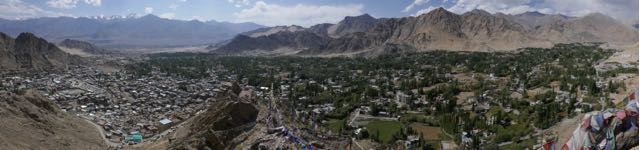
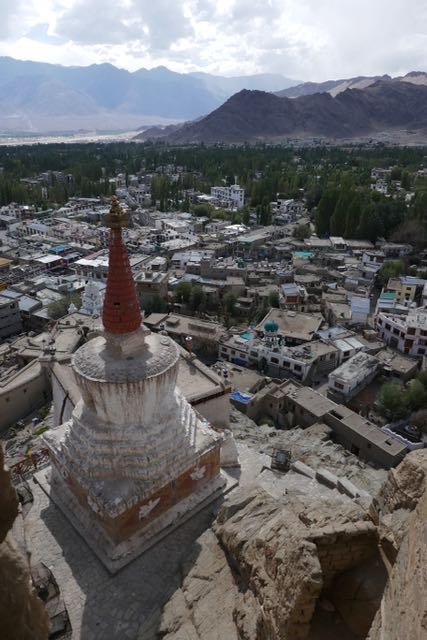
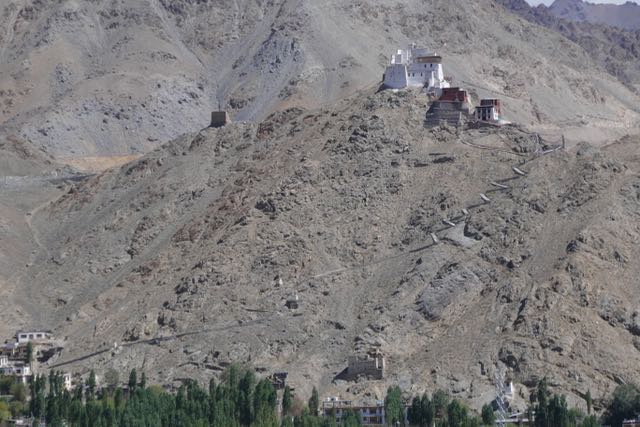
View from Tsemo Fort

I fell in love with Leh before I’d even landed.  The mountains, the views, the people, the air;  its whole aura, somehow.  If I lived in Delhi, this would be my bolthole from the summer’s heat.

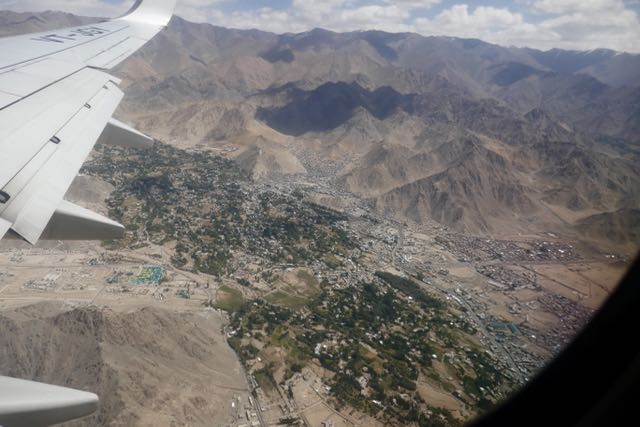
Leh from the air

On a clear day, the view from the Delhi flight is phenomenal, snow-capped peaks and winding streams of glacier-flow, no apparent sign of human activity until you near Ladakh’s capital and spot the first signs of cultivated fields beside grey-green rivers, a stark contrast to the barren, unforgiving landscape around.  As with Paro in Bhutan, it seems incredible that there’s any stretch of flatness big enough for an airstrip, and indeed the airport building itself is up the hill from the apron. 

Namgyal Stupa from Leh Palace

Too excited to remember to check my seat pocket before getting off the plane – you’d have thought that I’d have learnt by now after inadvertently donating one mini-CD player (remember those?), two CDs and one iPod over the years – I had to wait around for a kind crew member to reunite me with my glasses, so found myself practically the last to leave the airport, and emerged entirely un-hassled.  In fact I had to find someone to ask about a cab to my hotel.  A far cry from the craziness of the madding crowds outside most airports in this country.  I could have been forgiven for missing the taxi “desk”:  it’s the back seat of a parked car, the sign initially hidden from me by the men around it.  While waiting for someone to decide if I was worth the fare, I looked around.  The airport looked as if it was closing up for the day, business done by lunchtime.  The asphalt outside had been so newly laid I picked up my feet gingerly, half-expecting to stick to the ground.  The sky was that brilliant blue of the unpolluted mountain atmosphere, and the air clear and energising after the enervating late-monsoon heat and humidity in the capital.

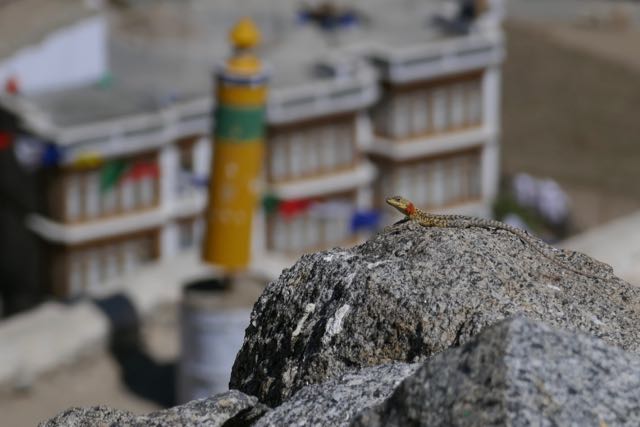
Himalayan agama, Shanti Stupa

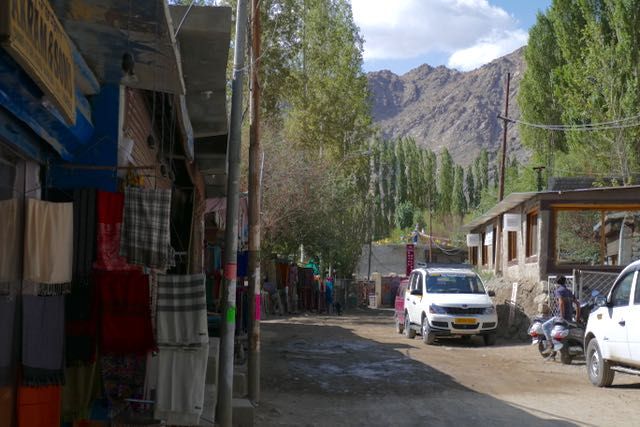
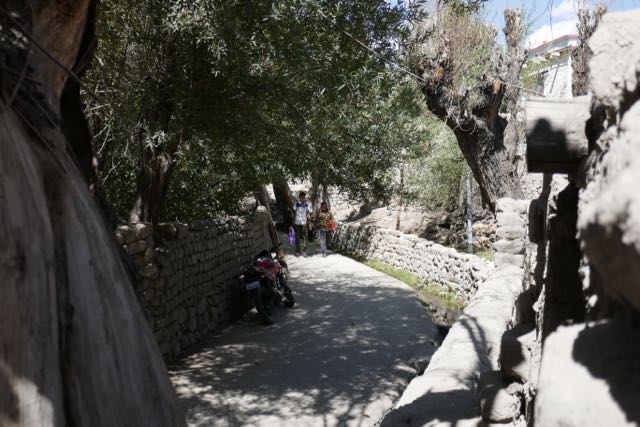
On the short journey to my hotel, images crowded my mind.  “San Pedro de Atacama,” I thought, looking at the narrow mud wall-lined streets.  “No, the Wakhan,” spotting the carved pine window frames and mud-brick construction.  “Or Bhutan,” looking at the shape of the houses.  Or in fact something just a little bit different.  With its poplars, willows and apple trees, and network of irrigation channels, the Leh valley is remarkably tranquil.  A town of 30,000 people, it is wonderfully easy to leave the (limited) crowds behind and scramble up a hillside or walk up a deserted lane.

Assuming the altitude hasn’t hit you, that is. 

View from Leh Palace

Flying to an elevation of just over 3,500 metres (11,500 feet) without acclimatisation (I’m not sure that a week in McLeod Ganj and Shimla, down at 2,000 metres or so, count for much) is likely to affect most people, even if only briefly.  The airline and airport staff make announcements to the arriving passengers, warning them of the dangers of altitude sickness, and my wonderful hosts were most solicitous of my wellbeing, keen to test my oxygen levels with a small gadget they keep readily to hand, and regularly asking after my health.  Because, for once, it was hitting me.  Not badly – only to the tune of a headache, an extreme reluctance to eat (hugely uncharacteristic!), and persistent light-headedness – but enough to make me appreciate the way that travelling companions have been affected in the past.  I knew what to do:  take it easy, drink lots, eat regularly, and sleep.  That last bit was very easy, and I road-tested the bed in the lovely Adu’s Eternal Comfort almost as soon as the taxi driver had put down my bag.

Room with a view

Waking a couple of hours’ later, I took stock of my surroundings.  My vast room looked north to the mountains.  Only a few houses punctuated my view and those were as spaciously set out in their flower-decorated grounds as my own guesthouse.  On the landing outside my room I was surprised to see a bare set of concrete steps leading up to the next floor… or what might be the next floor one day.  In the meantime, the opening above the steps was covered by a blue tarpaulin.  Behind me, the impressive marble staircase that curved up from the front door arrived unadorned at my floor – no bannisters, walls or anything to shield the unsuspecting person from making more of a gravity-assisted descent than they might have intended.  The room on the far side of the staircase wasn’t a room, just a blank open space, as if awaiting further construction, and a door at the end of what would have been a corridor were it not for the current open-plan design, led me outside onto the roof of the floor below, pipework stretching across as though waiting for a floor to be put down on top.  When I met my hosts later, I asked Mrs Adu (to my chagrin, I never found out her actual name) how long they’d been there, expecting an answer in terms of months or a year or two.  “Ten years,” she answered brightly.  “Oh, um, it’s lovely,” I struggled to reply.  Perhaps, like London’s Lloyd’s Building, they are leaving it unfinished so as to be able to expand easily if and when the need arises.

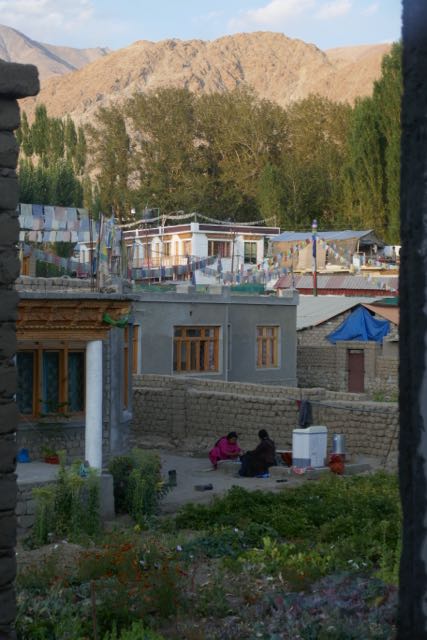
Leh side street

It’s not the only thing that’s unfinished in Leh:  the roads would test any vehicle’s suspension.  Tarmac hasn’t made it this far, at least not in any quantity.  This is an extremely arid area – with less than half the average annual rainfall of my occasional home in the Australian Outback – so shopkeepers regularly dampen down the road surface to reduce dust levels, though I felt they might be doing so a tad generously in the circumstances.  Water feels plentiful here with the number of streams running through the valley and alongside paths, but these are the product of generations of hard work creating irrigation channels, and tourists are urged to be cautious with water consumption.  The use of plastic is very gradually being reduced around India.  Delhi, for example, has been officially plastic-bag free for more than six years and the same ban has recently been implemented in Himachal Pradesh.  Here in Leh you are encouraged to refill your water bottle for only a few rupees at one or other of the places providing purified water.  (I have to admit, I still added my own purifying tablet – I just didn’t have time on this trip to accommodate gastrointestinal difficulties.)

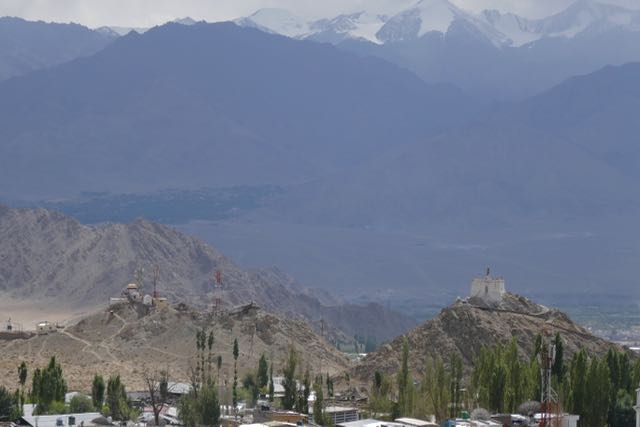
Tsemo Fort from the path up to Shanti Stupa

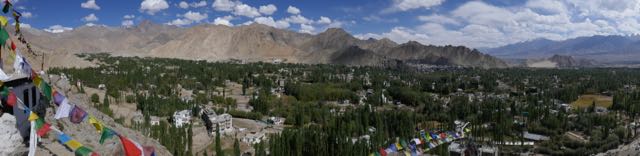
So much for my intention to take things easy.  The next morning, after a late brunch of excellent porridge at a Korean restaurant – obviously – I mooched slowly up Changspa Road, away from the centre of town.  I had no plan, just to stretch my legs, and found myself walking up a dirt track from which I could make my way cross-country through a field of chortens  (was this perhaps some kind of graveyard?), towards the path up to the Tsemo Fort.  Yes, the Fort.  The highest “sight” in the immediate vicinity of Leh.  What was I thinking?  Not feeling so good, so let’s go higher, feel worse, come back down, and somehow feel doubly better?  I laughed at myself, but plugged on, taking it v-e-r-y slowly.  And it worked, or at least I didn’t feel any worse.  The reward for ascending each of the town’s three “elevated sights”, the Fort, the Palace and Shanti Stupa is, of course, the stupendous views, and, visited in this order, in my opinion, they just get better and better.  Snow-capped peaks twenty miles or so across the valley provide a perfect backdrop, and the only wrinkle in the near distance was a large car park I hadn’t noticed before and which now seemed to dominate the view every time I looked.  Between me and the mountains was the dun-coloured stone of the flat-roofed buildings, the brilliant green of the trees, the turquoise of the distant river, and the bright colours of the prayer flags.  And only a couple of other tourists.  Tearing myself away from here at the weekend was going to be tough.

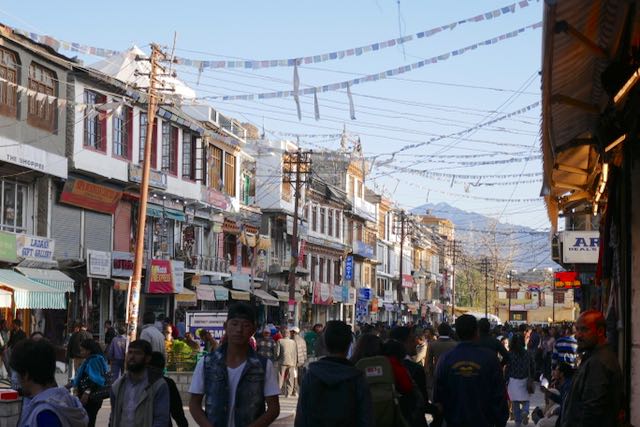
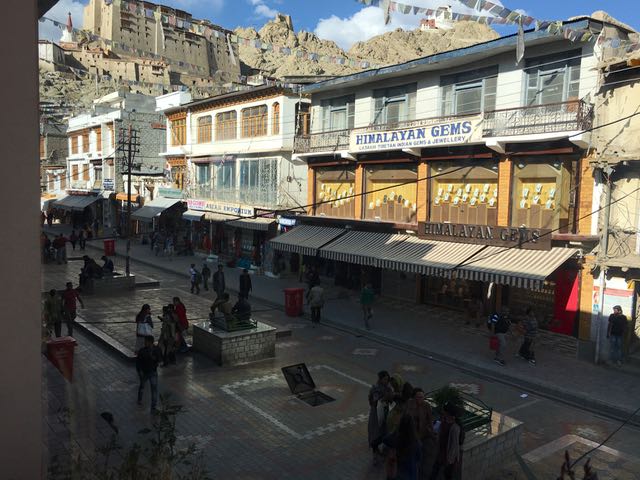
Main Bazaar

The people were as lovely as their surroundings.  Ethnically diverse, with – to my untrained eye –  at least Tibetan and Aryan influences (some fabulous green eyes!), as well as people from other parts of the country here for the short summer season (one café I visited was run by Goans, for example), they were delightful and somehow more considerate, if that’s the right word, of the tourists amongst them.  Or was it a lack of materiality, a more “Zen” approach to life?  No hassle here to buy stuff, book trips or visit particular restaurants.  Sure, I’d be greeted as I walked along the street – “Mam, you want to shop?” – but this would be called out from a seated position watching the world go by from his front step, or from the middle of a conversation with a neighbour, almost cursorily, as if doing the minimum necessary to attract business.  If I demurred and carried on, there was no follow-up except perhaps an “OK, bye”.  Greeting people on my peregrinations around town with the ubiquitous “joo-lay” – simultaneously “hello”, “goodbye”, “please” and “thank you” – would reward me with a warm smile.  By my last afternoon, I felt as if I was bidding farewell to friends, with a hug from the girl at the Lehling book/coffee shop, good wishes from the waiter at the Bon Fire restaurant, and the hope that I’d come again from Mr and Mrs Adu.

Coffee shop with a view

I can be a creature of gastronomic habit when I’m on the road.  If a place works for me – location, service, food and drink – I’ll go back.  Often repeatedly.  After all, I’m not looking to write a culinary guide to the area.  Whether a subliminal desire for a “home”, however temporary, somewhere I’m recognised and greeted, the lone traveller briefly not alone, I don’t know.  More prosaically, in Leh I was simply lucky enough to find two places that suited me admirably.  The Lehling shop on the first floor above Main Bazaar provided wonderful people-watching potential.  Its coffee could kick-start the dead, while its bookshelves could have added a lot more weight to my luggage than they did.  And Bon Fire provided several of the “Ladakhi dishes” that the Book had mentioned (as far as I could taste, each one seemed to involve some form of pasta or noodles with vegetables in a thin broth of varying spicy-ness, but I wasn’t complaining), and was within easy reach of my guesthouse, no mean consideration when street-lighting is limited and power cuts not unknown.  And one evening it also produced Coke-the-badly-behaved-but-mega-cute-puppy, who spent most of the evening attempting to eat either my bag or my jacket, and made a fair attempt at pulling off the tablecloth a couple of times, though without the adeptness of the expert who would have left the crockery in place.  In between, he fell asleep on my foot, so I couldn’t be cross for long.  If he wasn’t so clearly owned and loved by my waiter, I’d have been sorely tempted to smuggle him home.

Leh side street

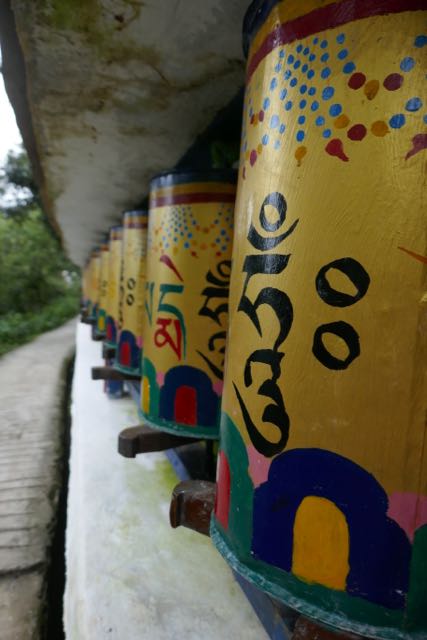
The one plus of being a bit altitude-y was that I didn’t feel at all guilty about not venturing further afield.  Of course, trekking is “the thing” here, trekking companies and outdoors stores outnumbering souvenir shops in places, but I was content to meander around the town.  The alleyways and side streets provided something new and interesting at each turn.  From an unexpectedly large and beautifully decorated single prayer wheel, to a shop that bore my own surname.  I’m told “POSH WEIR” means flower garden in Ladakhi… who knows?  But the owner regarded my appearance – my name confirmed by a detailed perusal of my passport – as a good omen.  He told me later that, just after I left the first time, having purchased a token couple of pairs of earrings, he sold a number of pictures to some Italians, and, when I returned to reconsider a fabulous wall hanging that had been preying on my mind all afternoon, he was mid-negotiation over a rug or two with an Australian.  He and I came to an agreement over the price of the hanging unexpectedly quickly and, from my point of view, extremely agreeably.  He was having a good day, and I went away very content with my purchase.

Such was my ninth trip to India.  I left with promises to my Delhi friends not to leave it another six-plus years, and even tentative plans to return next November.  There’s so much more to see.

View from Shanti Stupa

Tibet in India

Here in McLeod Ganj, a pretty corner of Himachal Pradesh’s Dhauladhar mountains, India gave the Dalai Lama refuge after he fled Tibet in 1959.  Otherwise known as Upper Dharamsala, it is the tranquil, scenic end of town, set 500m up the mountain from its transport hub and scruffy market town counterpart in the valley.  Halfway between the two, Gangchen Kyishong is the home of the Tibetan Government in Exile which undertakes political advocacy and administers to the educational and cultural needs of the roughly 100,000 Tibetans now living in India. 

Prayer wheels, Tsuglagkhang kora

When I was approaching Lower Dharamsala, I had found myself wondering what I was actually doing here.  I’m lucky enough to have been to Tibet, albeit to a necessarily limited extent;  yet by definition I have seen infinitely more of their home country and much more recently than the people I would be encountering over the next few days.  Many, of course, would have been born in exile and might never see the country they still call home.  I felt guilty and a fraud:  what right did I have to have seen their home country when they were unlikely ever to do so, or ever to do so again?  The Dharamsala area attracts a huge number of people, whether to enjoy a dose of Tibet-by-proxy, to pay homage to an incredible religious leader, or to help refugees in a foreign country.  I didn’t really fit into any of those categories.  Apart from the fact that, like George Mallory’s reputed rationale for tackling Everest, I was visiting McLeod Ganj “because it’s there”, I couldn’t remember why I had put it on the list.  Maybe the Mallorian answer would have to suffice for now, and the guilt was just something I’d have to swallow.

Main Square, McLeod Ganj

This was the second of the long travel days on this trip, and I was decidedly sceptical about whether it was going to work.  I’d psyched myself for a long day on the road.  The online booking platform for buses in India, redBus.in, gave only one arrival time for the Shimla to Dharamsala route, regardless of which bus you chose.  Each one of the six throughout the day was due to arrive at “00:05”.  If you took the 21:30 option, that would be simply miraculous.  Although only a distance of 242 km, it would require nothing short of a magic carpet to reach Dharamsala in that kind of time.  I was booked on the 09:40, and I sincerely hoped I wasn’t in for a 15+ hour journey.

what’s in a name?

We stopped for lunch at 2.45pm, randomly – or so it seemed – pulling over into what might generously be called a layby, opposite a large but simple restaurant.  The driver’s assistant gave some sort of instruction which triggered barely perceptible movement in my nearest neighbours, the rocking movement of the bus having lulled them into some kind of zombie state.  I hazarded a guess that this was at least a “bio break” (to quote my former American colleagues), and hauled myself out of my seat into the not-very-fresh air, and then realised that food must also be involved when I saw the driver comfortably seated inside the restaurant.  A range of food was being ordered.  I’m fortunately not given to travel sickness, but I can’t say the same for at least a couple of my fellow travellers, and even I wasn’t going to order anything adventurous.  Roti and raita would suffice.  Half an hour later, we hit the road again, only to pull over into a bus station a little further on where we disgorged about half the bus-ful.  How frustrating to be so near your destination and yet waiting out the time at a nothing-much eatery… or maybe that’s my impatient London head talking.  No-one seemed remotely bothered.  I looked at my map.  We were in Hamipur, only half-way.  I braced myself for another six hours on the road…

McLeod Ganj from the Bhagsu road

…and was pleasantly surprised when, barely two hours’ later, we passed a sign saying “Dharamsala 14 km”.  Whatever the state of the road, I could walk from here, if push came to shove.  It certainly pays to be pessimistic.  The Lonely Planet had quoted ten hours for the trip, I’d assumed twelve, dreaded fifteen, and we’d made it in a little over nine.  While the road down the mountain from Shimla is pretty bad, narrow and winding, the road along and up from Hamipur was much better, properly two-way and well surfaced.  Now to find a taxi to take me the last 4 km up to McLeod Ganj – “Very steep road, mam,” I was told by the taxi agent when I queried the fare.  Wear and tear on the clutch costs money.

A view to get up for

The next morning, I woke to the sound of the river far below as well as intermittent birdsong:  deliciously un-Indian, not one car-horn interrupting the tranquillity.  I opened the curtains and found myself with a tree-dominated view through which peered the two high peaks I’d seen the night before, the highest of this trip so far, gloriously lit by the sun against blue sky.  Beaming widely, I threw on some clothes and scampered up the four floors to the Hotel Moon Walk Residency’s restaurant and outside terrace.   (Yes, I admit, the name of the hotel had been a factor in my decision-making process a couple of weeks’ earlier.)  It was a glorious morning, the sun streaming down, and the mountains looking temptingly benign.  They were to prove a useful weather-gauge.  If the mists were coming down from that direction, I’d stay indoors or make plans to take shelter in the next hour or so to avoid the resulting rain.  The weather oddly didn’t detract from my enjoyment of the place.  It was late monsoon season, so the rains weren’t unexpected, but I couldn’t help thinking that, as with Glencoe in the Scottish Highlands, there was something just as appealing in the mystery suggested by mists and cloud as the dramatic spectacle revealed by the sunshine.

Horrifying reading

I’d arrived after dark, and soon realised my bearings were out when I found myself walking downhill and reaching the Delek Hospital (“NO HORN PLEASE” – good luck with that on such a steep and bendy bit of road) and the gateway to the Central Tibetan Secretariat, both of which I’d noticed on my taxi’s climb up the mountain the previous night.  However, what I hadn’t spotted before was the wall of missing persons notices.  Well, not exactly.  These are some of the monks and nuns who have self-immolated in protest at the Chinese government’s actions over the last few years, and their faces are all around McLeod Ganj.  I was particularly heart-struck by the pictures on the wall halfway round the kora, the ritual circuit, of the Tsuglagkhang Complex.  Here were 100 Tibetans, including many ordinary people, who committed this awful act of protest in 2012.  Pretty 23-year-old Tingzin Dolma in her bright red rain jacket, looking like a girl out for a day’s innocent fun with her friends.  The wind-reddened cheeks of 30-year-old Kalkyi.  She’s in traditional dress, a look of hard work in her eyes.  Laughing Kynchok Woeser, a 23-year-old monk, his prayer beads wrapped around his wrist, photographed with a momo raised to his lips, the second before he takes a bite.  And 18-year-old Nagdrol, his long hair flopped over one side of his face in the close-up photograph.  A smile plays on his lips, though his eyes remain serious.  One young man is photographed already engulfed in flames and running.  I couldn’t see his name, his picture being on the top row, but he’s shouting as he runs, and somehow I feel he’s shouting his cause, not screaming with pain.  His eyes are wide open, not squeezed shut in agony.  I cannot begin to imagine what would drive anyone to this awful act, such strength of belief in a cause.  I felt utterly humbled.

Buddhist monks

It’s hard to get away from politics here.

Looking through my own photographs just now, I see that the weather has leeched out colour, and that seems to reflect my impressions, my mood as I think back to McLeod Ganj.  The Tsuglagkhang Complex is the exiles’ replacement for Lhasa’s Jokhang Temple, but it’s necessarily built of concrete and feels more like university accommodation than a place of worship or quiet contemplation.  The centre of town is filled with souvenir shops, including many selling purportedly Tibetan textiles and artefacts, but somehow the atmosphere is more like a mini version of Kathmandu’s Thamel district, though mercifully without the hassle – none of the “You want taxi? Trekking trip? Hashish? T-shirt?”  There are monks and nuns a-plenty, of course – red-robed figures an erstwhile companion affectionately called “Buddha guys” – and, from a practical perspective, I’d be tempted to conclude that they appear to be better off here than back in Tibet, certainly in material terms.  Universally, for example, they seemed to be well shod – I admired the wonderfully deep red trainers that coordinated perfectly with the monks’ robes.  Many had smartphones, glued to their ears or the subject of their fixated attention, like teenagers in the West, and some carried golf umbrellas.  Lay Tibetan women were dressed in the dark dresses and bright aprons that I’d remembered Tibet from ten years’ ago, but seemed to carry themselves more proudly here, more dignified, not here in India the second-class citizens that their cousins and friends are forced to be in their own country back home.

Town centre, McLeod Ganj

The next day I left McLeod Ganj behind, at least for an hour or two, and went to explore neighbouring villages.  It was wonderful to escape buildings and people, and to walk through trees, enjoying natural scenery, something which hasn’t been a feature of the vast majority of my previous Indian peregrinations.  Of course, there was still the odd too-fast driver or motorcyclist, intent on announcing their impending arrival with plentiful use of the horn, but, over the entire trip, I was only to encounter one driver who seemed to speed up on seeing me;  generally they allowed enough space for the poor pedestrian, though it pays to be cautious and stand to one side, particularly if two vehicles are about to pass each other.

Popular Sunday excursion

Bhagsu – properly Bhagsunag – is only a kilometre or so round the mountain from McLeod Ganj.  Its centre was even more chaotic than its neighbour’s because vehicular traffic is banned beyond that point.  Here the chaos was the result of the incomprehensible game of bumper-cars that is an Indian car park, whether official or not.  I remember being bemused when I first encountered this in Delhi in 1994.  The volume of traffic was such that cars would be abandoned haphazardly, the handbrake left off so that enterprising parking-wallahs could push the cars around as required to liberate vehicles required by returning owners.  Here in Bhagsu, beyond the bumper-car arena the lanes narrowed, once again lined by tourist-enticing stalls and shopfronts.  I walked past a nondescript but elderly Shiva temple and a male-dominated open-air swimming pool (it’s inconceivable that women would participate in such a public set of baths in India), and found my target, the track up to Bhagsu’s main claim to fame, its waterfall.  Me and hundreds of my closest friends.  You do very little in India on your own, or so it feels most of the time.  It was a Sunday and the atmosphere holiday-like, everyone out to enjoy the break in the monsoon – thunder had punctuated the previous night’s sleep and I’d woken to continuing rain which I’d waited out until it eased off at midday.  (I may travel to India a fair amount, but I’m still very British in regarding rain as something to be avoided where possible, rather than, Indian-ly, actively sought out and enjoyed for the relief it brings from the stultifying heat.)  Enterprising locals had set up a range of distractions along the kilometre or so of track, from abseiling down what must be pretty tiny cliffs, to the provision of sustenance to counter the (very minor) challenges of the trek.  All ages were there, kids being carried across the rocks in the river, courting couples impractically clothed and shod, young men showing off to their mates.  As I turned for one final photograph of the falls, I noticed the tops of the mountains were once again shrouded in mist.  I’d be keeping an eye on the weather for the rest of the afternoon.

Church in a time-warp

Back in McLeod Ganj’s Main Square – better described as “main chaos”, there being nothing square about this small area coping with two-way traffic from seven or eight different directions – I took another of the feeder roads.  This one led slightly downhill, past an extended and typically overflowing parking lot, where people driving up from Lower Dharamsala leave their vehicles, and round the next valley in the opposite direction to Bhagsu.  My destination was one of the oldest colonial remains in this area, the delightfully named Church of St John in the Wilderness.  Almost invisible from the road, the church inhabits a time warp.  Its solid stone construction is out of keeping with the concrete haphazardness of McLeod Ganj, albeit its roof is now decorated with very Indian-ly practical blue tarpaulin sheets.  Inside, the solid wooden benches and pretty single stained glass window are augmented by rows of plastic chairs, dripping strings of white fairy lights and a couple of neon strip-lights.  Even with the main road to Dharamsala just above, it feels tranquil, sad, forgotten, in amongst the Himalayan cedars.  In the grounds is an impressive memorial to James Bruce, Earl of Elgin and Kincardine and former Viceroy of India, erected by his widow, Mary Louisa, in 1864.  Their Victorian finery in this setting?  Yes, I could just about see it.

Unlikely momo heaven

On a more frivolous note, McLeod Ganj brought back gastronomic memories of Tibet and Bhutan with the momo, small steamed (for preference), half-moon-shaped dumplings, usually filled with mince or chopped vegetables.  I’d found myself consciously avoiding Book recommendations, and looking for somewhere “local”, with atmosphere and people-watching potential.  On the way towards Bhagsu, I found a tiny roadside shack, the kind of place that’s often filled with men, the locals unintentionally making it a little challenging for a female tourist to enter.  However, here I could see a woman inside the doorway, part of a tightly-seated octet of Indian tourists.  The cook, almost invisible in the depths of the tiny crowded kitchen area, nodded doubtfully at my request for momos, “Ten minutes?”  Clearly he wasn’t expecting me to wait – Westerners=Impatience – but what better guarantee of freshness?  And these were definitely worth the wait, accompanied by the owner’s proudly homemade chilli relish and multiple cups of masala chai.  In the meantime, tourists had left, replaced by the owner and cook having their own tiffin-delivered lunch.  A couple of wee lads appeared, one of whom I could see out of the corner of my eye, staring avidly at my diary scribbling, though he’d jerk away, feigning a lack of interest, if I looked up.  There was a map of the world up on the wall.  I chatted a little with the two men, the owner’s English being particularly good.  He was curious, pointing towards the North Atlantic.  “All sea?”, he asked incredulously.  He asked where I was from, where I’d flown to, how long it took, shaking his head at my answers.  Another world.

Unnamed temple, central McLeod Ganj

(I didn’t notice buttertea, that other Himalayan staple, on any menu, and I have to admit I wasn’t exactly inconsolable.  The only time I’ve actually enjoyed the oddly savoury confection was at the end of a day’s trekking in Bhutan where we were wet and tired, and buttertea was part of the lavish hospitality showered upon us in a mountain village.  Hot liquid of almost any description would have been extremely welcome in those circumstances, and I went back for more.) 

hut décor in Bhagsu

There’s nowhere like India – well, Lebanon came close – for making the exhausted tourist in need of a refreshing long one feel quite so much like a fallen woman.  Rather than pay someone from an ostensible  drinking establishment to purchase me a beer – the previous night, the neighbouring Hotel The Vaikunth’s advertised “BEER BAR” appeared either fallacious or closed for a private function (it wasn’t clear from the explanation I didn’t get when I asked), so one of the waiters had gone out to source the evil liquid specifically – I raided the shop myself, braving the bemusement/opprobrium of the owner, and carefully hiding the merchandise in my shoulder bag to avoid a similar reaction in my own hotel’s reception staff.  Sipping my “super strong”, “high power beer”, GODFATHER, in my room, I felt like a naughty schoolgirl… and it was delicious.

So that was Himachal Pradesh, or the infinitesimal amount of this fascinating and challenging state that I was going to see on this trip.  Next stop, Ladakh. 

Towards lower Dharamsala

Shimla – a watershed city

Shimla in the monsoon clouds

Three things I didn’t know about Shimla a week ago.

Hanuman disciple

It is the administrative capital of Himachal Pradesh and, although originally “devised for an anticipated peak population of 45,000, at the most 60,000”, its metropolitan area now contains nearly 300,000 people.  This is no sleepy remnant of a colonial past but a bustling, busy place.

The ridge on which it sits forms a watershed between the Gangetic and Indus river systems.  It cleaves the subcontinent in two, one system flowing into the Arabian Sea, and the other into the Bay of Bengal.

The Viceregal Lodge

And, despite recent saturation coverage in the British media about the seventieth anniversary of Indian independence, I had managed to miss that it was in Simla, as it was then known, that the key independence negotiations took place.  Appropriately, given the way in which the city’s location divides the subcontinent’s river systems, this is also where that awful division of the subcontinent’s peoples, what became known as Partition, was first discussed.  The guide at the Viceregal Lodge pointed out what is now known as the “Partition table” – and, oddly, whether as a result of poor workmanship or too much banging of the table during negotiations, there is a crack across its diameter.

Lower Bazaar

Going one stage further, while sheltering from the monsoon rains in the Book Café (instantly my favourite place in town – two of my most-loved things under one roof), I read that it could be argued the very fact that the British moved their imperial capital to the isolated mountain resort of Simla in the 1860s could itself have contributed to the nature and shape of Independence, as well as to the very fact of Partition.  Had the colonial government, first in Calcutta and then in Delhi, remained more closely connected to public opinion, seen its strength, and been more responsive to the nationalists, might they have been more open to the early suggestion that the entirety of British India be granted self-governing status under the British Crown?  Might independence in this form have come earlier?  Could the bloodbath of Partition have been avoided?

My historian days, such as they ever were, are long ago.  I never studied this period, and “alternative history” is always endlessly intriguing.  I’ll leave it there.  But history and politics were my constant companions as I walked around the city; there was no escaping them.

Chaat-wallah waiting for the train’s business

I was cramming an un-Indian amount into this my ninth trip to the country, and the days spent travelling to and from Shimla were going to be particularly susceptible to “India wins again”.  The first challenge was to get from Delhi into the mountains.  I soon found out that Shimla’s nearest airport, Jubbarhatti, was not currently taking commercial flights: not wildly surprising when you read that the airport was “constructed by cutting down a mountaintop and levelling the area to form a single runway”, and that its apron can only accommodate two small aircraft.  Kingfisher Airlines, operating the then sole daily flight from Delhi, could not carry more than 28 passengers on its return journey due to load restrictions resulting from the high altitude, and ceased operations in 2012.  Instead I booked a flight to Chandigarh in northern Haryana, working on the basis that I’d then be able to get a taxi from the airport the 45 minutes or so up the road to Kalka where the World Heritage “toy train”, the Himalayan Queen, would begin her tortuous route to 2,200 metres above sea level.  While this would involve a very early start and some hanging around, it did at least seem to allow enough contingency in the connections.  But then Prateek suggested I consider the Kalka Shatabdi Express.  Due to leave New Delhi Railway Station at 7.40 am, this would give me an extra hour in bed (never to be sneezed at), and, from what we could discern from both official and unofficial sources online, this train is supposed to be a recognised connection for the 12.10 pm Himalayan Queen.  Nothing in this world, let alone Indian transportation, is to be taken for granted.  Absolving my host of all liability should this not work out (after all, we had met, all those years’ ago, as law students at university), I opted for an extra hour’s sleep.

Halfway up the mountain – Solan

Indian railway stations still make me more than a tad apprehensive.  I think I’m still scarred from my first experience in January 1994, during my first trip to India.  I remember crowds that would make London’s Oxford Street during the sales seem like a walk in the park, and our own blanket incomprehension on every level:  signs entirely in Hindi, unable to make ourselves understood, unable to understand, being directed to counter after counter.  We only wanted tickets to Agra a few hours’ away:  surely it couldn’t be this hard.  It was.  We slunk back to Niti’s place and she, taking pity on us, kindly arranged for one of her staff to sort it out.

Monsoon lushness

By 2011, New Delhi station at least had begun to take pity on the poor old firangi.  There was a separate booking area upstairs, away from the crowds.  While I balked at the segregation, I hoped that we would at least be charged for the privilege and I had to admit it did make things easier.  For logistical reasons, however, I was spared the ticket acquisition process this time around.  I was further spoiled:  Prateek had found out the platform for me and booked me a cab to the station.  All I had to do was follow the signs once I got there.

Glued to the hillsides

There are an awful lot of people at Indian train stations.  Quite how this happens given the “TICKET HOLDERS ONLY” injunction at the X-ray machine at the entrance, I’m not entirely sure.  I certainly don’t know how the sadhu managed to get what looked like an iron railing, complete with impressively pointy end, through security.  And, oh India, you’re not at your best in railway stations or near railway lines.  The smell of stale and fresh urine on the platform was enough to send me scampering back up the stairs to wait until the train was announced – I had only been back in the country 48 hours, and berated myself for my western sensitivities – and I ached for the people squatting in the open by the railway line as we headed out of Delhi, like some ghastly bowel-emptying convention, men and women alike.  In a country with pockets of sickening wealth, as well as both space and nuclear programmes, is the provision of basic sanitation and such an elementary level of dignity of no concern at all?

Grey langurs

By Chandigarh, I realised that we were running half an hour behind schedule.  There were plan Bs if the Himalayan Queen had already left – taking a taxi up the mountain or waiting for the first train the next day – and I tried to get myself into a kind of Zen, que sera sera, state of mind.  But curiously we arrived at Kalka only minutes before the Himalayan Queen’s scheduled time of departure, and then she was late leaving.  I sunk into my seat – or my replacement seat, one gentleman having already taken mine in order to sit with his friend; he proffered me his instead, a great exchange for me as it gave me a window seat with no-one in front of me – and sent up a brief prayer of gratitude to the travel gods.  This challenging day might just actually work out.

Spectacular in all respects

This was my second of the World Heritage-listed Mountain Railways of India, the first having been the Darjeeling Himalayan Railway.  My memories of the Darjeeling train involve more space, a shorter distance, the way it shared the main road with regular traffic, and how schoolkids jumped on and off, using it as a free lift back home.  This was very different.  It’s a scruffier train, and a 5-6 hour journey, times being decidedly approximate.  There were multiple stops, not so much for passengers to get on and off, but for the existing passengers to be refuelled.  Who needs an on-train service when you can simply walk across the tracks to the chai- or chaat-wallah?  I defy anyone to arrive in Shimla hungry.  In between times, the scenery was glorious.  Travelling in the late monsoon season meant the vegetation was looking luxuriant and everything freshly-washed.  Red and green corrugated iron roofs are clearly all the rage, so, coupled with a fair smattering of houses with painted walls, towns and villages had a cheerful appearance.  I’d grinned happily at the sudden sight of pointy hills rising from the plains as we approached Kalka on the Delhi train, and now the mountains only got more intense, ridge after ridge like crinkled-up paper, each higher than the one before, as we crossed into Himachal Pradesh.  This railway, first completed in 1906, is a staggering feat of engineering.  Some of the bridges were gorgeous, row upon row of stone arches, and tunnels that made me wish that the same engineers had also worked on London’s Blackwall Tunnel, all too frequently closed and/or clogged with oversized traffic.  The literature talks of 988 bridges, 102 tunnels and 917 curves “many of which are as sharp as 48°” on this 96 km stretch of track:  I didn’t count, and simply watched the altitude numbers on the station signs slowly increase.

Coinciding religions, Hanuman and Christ Church

Unannounced – surely a fanfare would be in order after that journey? – we slipped into Shimla station.  Almost anticlimactically, I made my way along the two contiguous platforms and out into the jampacked maelstrom of an Indian station taxi rank.

My hotel had known my mode of travel and likely time of arrival, and greeted me proudly with “Mam, we have upgraded your room from a deluxe room to a super deluxe room!”  Truly the travel gods had overdone themselves today.  I don’t know what I wouldn’t have had, as it were, but my “super deluxe” room was stunning, with a glorious view across and down the valley in the dying rays of the sun.  I’d been told, apologetically, that they didn’t have a restaurant, but they did have room service.  Even more perfect.  I took a much-needed shower and settled down to ponder the menu.  A truly fabulous day on the road, or should I say rail?

Shimla resident

Shimla remains extremely popular with domestic and Bangladeshi tourists seeking relief from the heat of the plains and, at this time of year, the plains’ heat coupled with humidity.  I’d left Delhi in 37°C and 70+% humidity.  In Shimla, it was an easy-on-the-tourist 21°C during the day, albeit the humidity levels hadn’t dropped.

Lakkar Bazaar

Hill stations have one huge advantage.  While going up- and down-hill is a hassle or a fantastic workout (depending on your perspective), you can pretty much be assured that “up” is where it’s at, and so it was in Shimla.  Maps in this kind of environment are challenging – how can you illustrate the myriad of steps and paths linking one contour-following road with another?  It pays simply to follow your nose, and the gradient.  The centre of town is gloriously pedestrianised so, unlike many Indian cities, you’re not actually fighting vehicular traffic every step of the way.  I wound my way up, following a likely looking set of steps that debauched onto what I later learnt was Lakkar Bazaar.  I headed on up, and found – and instantly fell in love with – the Book Café.  I never did work out its relationship with its books.  They fairly obviously weren’t for sale, and comprised pretty much everything – in English at any rate; I can’t speak for the Hindi – from histories of India in general and Shimla in particular, to modern novels and even “Harry Potter and the Cursed Child”.  Unlike many such establishments, they don’t cram in the punters.  Narrow tables line the walls, and here seem permanently to be seated teenagers and students, all beavering away in silence.  I only hoped for the sake of the business’s profits that they bought some sustenance from time to time.  It’s run by prisoners currently serving time in the Shimla jail and assists in their rehabilitation process as well as providing a supplementary income.  I obviously didn’t know anything about the background of the people working when I was there, but they were delightful, cheerful and wonderfully helpful, and I can’t recommend the venture too highly.  The coffee was great too!

The Ridge

The Ridge is Shimla’s Trafalgar Square, but a curious elongated triangular version.  At the “fat” end is an unexpectedly Tudor-style building that houses the municipal library, as well as a statue of Gandhiji and the invaluable city landmark, Christ Church.  While the latter is, in daylight, looking in need of a repaint, it is dramatic by floodlight as I discovered on my last night when I finally prised myself away from the room service menu in search of Shimla-by-night.  A massive Indian flag halfway along one side of the Ridge lies limp until the wind picks up with the late afternoon monsoon rains.  I haven’t consciously seen huge flags in India before, and this was the third in as many days.  To my mind, it seems in line with Narendra Modi’s “India First” mantra, although my Indian friends couldn’t point to any particular edict to this effect, and in fact the prime minister is alleged to have insulted the national flag on several occasions.  Nevertheless, the sight was unnerving.  My previous experience of large flags – North Korea, Tajikistan and (by reputation) Turkmenistan – is that they are militaristic, often indicative of a dictatorial-type rule that feels the need to proclaim its national fides.  With Modi’s government not being without controversy, it made me shiver.

Scandal Point

At the far end of the Ridge is the official centre of town, the delightfully named Scandal Point.  Frustratingly, the source of its name remains a mystery, one common hypothesis being that it marks the scandal caused by the elopement in 1892 of the Maharaja of Patiala, Bhupinder Singh, with the daughter of the British Viceroy, but recent research suggests that this Maharaja would only have been a baby at the time.  If the story relates to his father, who is known to have had an English wife, it’s impossible to confirm because all surrounding detail of that relationship has faded in the mists of time. 

Knife and scissor-sharpener

Below Scandal Point, the Mall peels away in both directions.  Another pedestrianised street, it stretches for 7 km to the Viceregal Lodge, and provides an invaluable point-of-reference for tourists visiting the city.  No doubt the prices in its shops are appropriately inflated.  While I was happy to lose myself in the densely packed shelves of the Asia Book House on the Mall, I found myself far more at home on the level below, the Lower Bazaar, where “real Shimla” shops for its necessities.  Here I found fruit and vegetable sellers, specialised purveyors of everything from toiletries to balls of wool and motorbike tyres, and people who could fix anything.  An elderly Sikh scissor-sharpener kindly agreed to my request to photograph him as his foot pumped away to turn the huge wheel of his trade.  I’d forgotten how India can fix anything.  Back on Lakkar Bazaar I later found an elderly lady fixing umbrellas.  I meant to get her to sort out an errant spoke on my Poundland special, but by the time I got back there, the rains were falling and she’d packed up her open-air workshop.

A would-be film set

Colonial architecture is everywhere around the central spine of the city, in varying degrees of repair and disrepair.  The grandly-named Gorton Castle now houses the state accountant-general’s office, though macaque monkeys run amok in its grounds and one upper window still bears the sooty scars of the 2014 fire.  Further back along the Mall, I’d found a gloriously Hitchcockian ruin, again now left to the monkeys, with no indication of what it had once been.  The Viceregal Lodge, however, is in good shape.  Officially renamed Rashtrapati Nivas at Independence, the old name continues to linger.  Now home to the Indian Institute of Advanced Study, with the former ballroom and dining room converted into a library, it nevertheless retains the grandeur of the original in the fabulous Burmese teak staircase and panelling, and the gorgeous unpainted Kashmir walnut ceiling of one of the ground floor rooms.  A few rooms have been set aside to exhibit photographs of the building’s past, primarily – of course – focussed on the Independence conferences which took place within its walls. 

The Gaiety Theatre

Renovation work is ongoing elsewhere in the city, with the Town Hall currently hidden under scaffolding and plastic.  The Gaiety Theatre almost suffered the wrecking ball in the 1990s after lying unused and unloved for years, but it was rescued at the last minute, and is now a pretty reincarnation of the intimate venue originally designed by Henry Irwin, the architect also responsible for the Viceregal Lodge.  Upstairs photographs of the earliest productions adorn the walls, though I can’t admit to knowing too many of the plays featured.  What, for example, was “The Merry Merchant of Venice”?  While great names have trod these boards in the past – notably Rudyard Kipling of whom it was said that acting was not his forte – it continues to host visiting theatre companies and local dramatic societies.  I was only sorry that the next performance was the night after I left.

Jakku Temple

Dominating the mountainside above the city is 33 metre pink-orange statue of the monkey god, Hanuman, first unveiled in 2010 and standing ten feet taller, so I’m told, than Rio de Janeiro’s Christ the Redeemer.  Warnings abound about the audacity of Hanuman’s simian disciples who rule the forest around the Jakhu Temple.  Walking sticks, with the added purpose of fending off the macaques, are available to hire for Rs10 but I decided to stand my ground, keeping careful grip of my possessions.  The walk up through the forest brought back memories of walking up to the Nikko Tōshōgō Shrine north of Tokyo in April last year.  The same heavy mists and eerie atmosphere.  But fewer people here, higher temperatures and potentially challenging wildlife.  For the most part, the monkeys seemed to behave, though it paid to keep a wary eye out.  I was reminded of the adage about sharks:  it’s the one you don’t see that gets you.  And, sadly, that proved all too true for one man while I was there.  A covered walkway takes you from the temple bell up to the main temple grounds, and provides the monkeys with an excellent vantage point for spotting those tourists who peep outside the protection of the roof to take up-the-nose photographs of the statue or scenic snapshots of the distant city peeping through the trees.  Sure enough, a Russian stopped to watch his friends trying for the arty shot, and found himself suddenly under attack from a large male macaque.  I yelped out a warning, but too late.  The monkey had reached up and grabbed the man’s glasses from the top of his cap, and bounded back onto the roof before his victim had time to draw breath.  There he sat, the thief, on the ridgeline of the roof, sucking thoughtfully on one end of the spectacles, for all the world like an absent-minded professor.  The Russian looked to be in shock.  Apart from the inconvenience of losing what were no doubt prescription glasses, being attacked by a large monkey must have been more than a little intimidating. 

Steps and more steps

Such was the first stop on this trip, a combination of history and monkeys, interspersed with rain and great food.  I felt elated to be back on the road after several years of largely UK-based and necessary distractions, and to be back on the road on my own.  While I’m fond of my erstwhile travelling companions, this is how I really love to travel.  Next stop, McLeod Ganj, if transport the next day played ball…

Indira Gandhi and the flag