
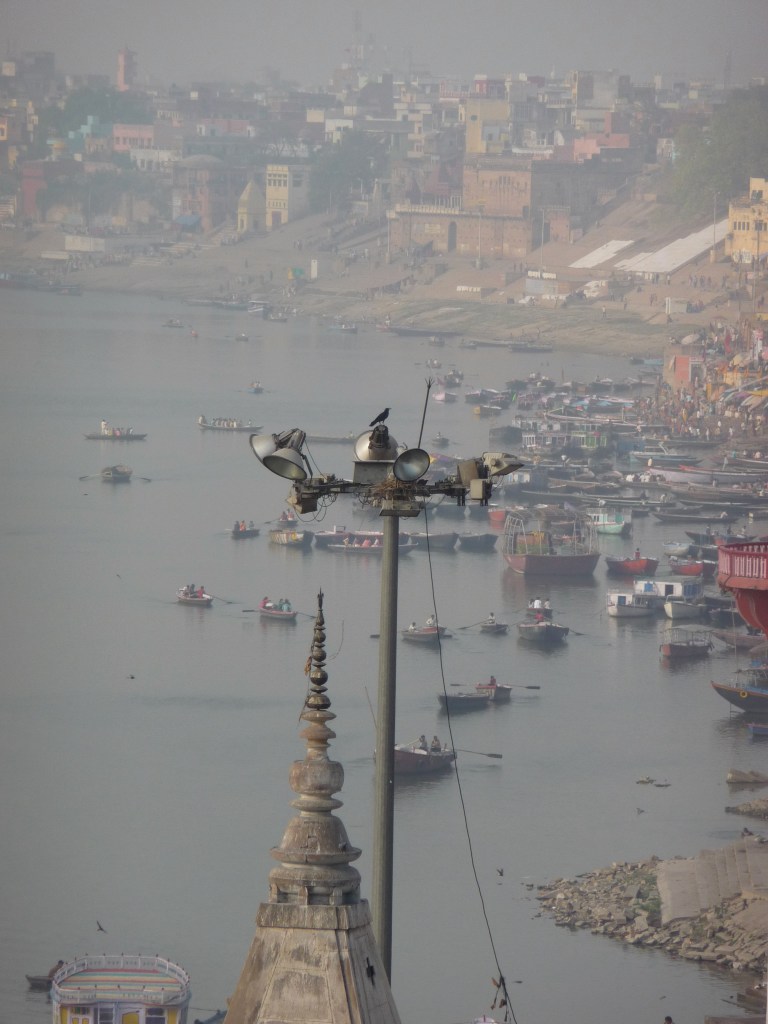
Varanasi is not to everyone’s taste, I discovered, canvassing both European and Indian views in advance.
“I didn’t like it… but then maybe we were tired. It was the end of five weeks’ rushing round India,” one travel-addict friend told me apologetically.
“It’s pretty intense,” said another, grimacing.
“Varanasi is great… enjoy it – it’s full-on India but I know you will be unfazed by it!” wrote an expat Brit in India.
“It’s how I imagine Westerners feel on visiting India for the first time,” said Radhi.
“But it’s filthy and dirty, how could you possibly enjoy it?” shuddered Kavita into her cocktail.
Varanasi, I concluded, even before the plane touched down, would be India Concentrate. For me, India fascinates, bemuses, enchants and frustrates, much like an errant or wilful but precocious child. She can be full of surprises when you’re least expecting them; she can be recalcitrant and determinedly obstreperous. She’s a joy and a heartache. She has a beauty far beyond the best photographer’s abilities, and she is unspeakably filthy. She is growing and developing, yet she is rooted in a past that goes back further than Western memory.

Varanasi is all of these. A story, a multitude of stories, in every frame, in every view, in every image.
Scuttling through the galis – the winding alleyways – of the old city in pursuit of my holdall, raised aloft my taxi driver’s head, and wondering how I’d ever find my way out again, I gagged on the smells, vowing to find myself a lightweight scarf to mask my face, as many of the locals do. I wouldn’t be wearing flip-flops here, I thought delicately: I’d rather my feet be protected from whatever was underfoot, solid, liquid or squelch. Yet around me were blasts of vivid colour, women’s saris, silks for sale; above me, fleeting snippets of history, an ornate temple tower, a carved mantle, a wrought-iron balcony. Smiles of welcome, stares of curiosity.

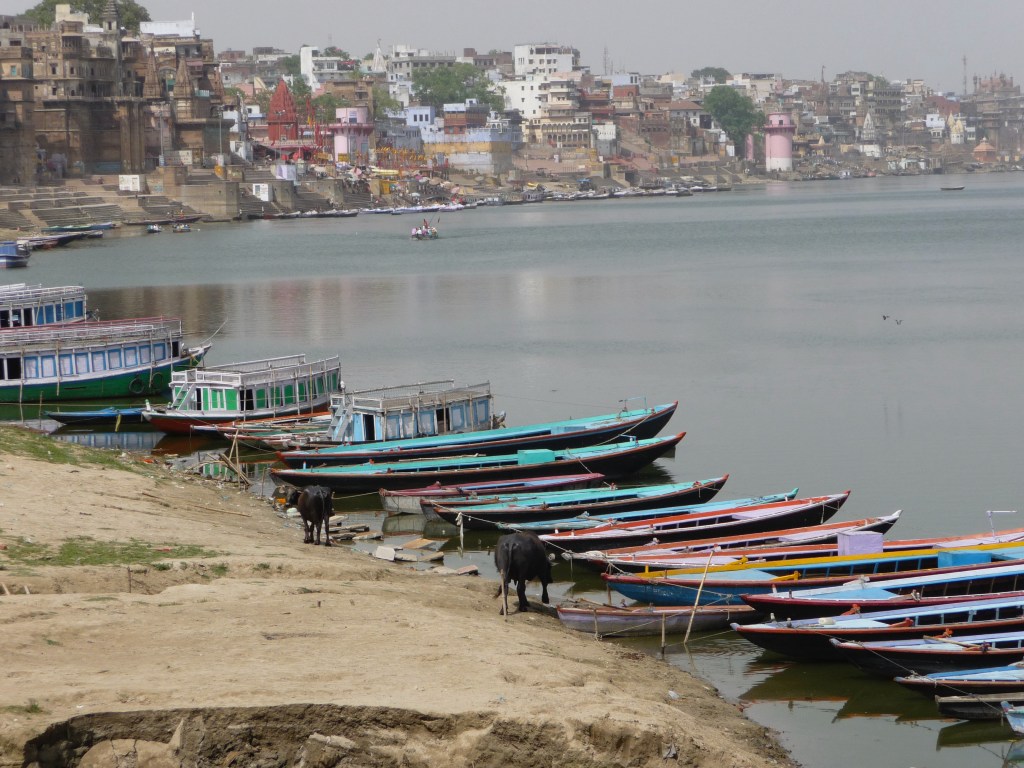
After what felt like an age in this maze, we were spat out and I found myself at the top of a flight of steps leading down to Ganga Ma, the great Mother of India, the River Ganges. Below, a jumble of people thronged her waters, their voices echoing up to me. Beyond, the floodplains, startlingly denuded of construction and, at first glance, unexpectedly empty of life: a stark contrast to the hubbub on this side of the river.
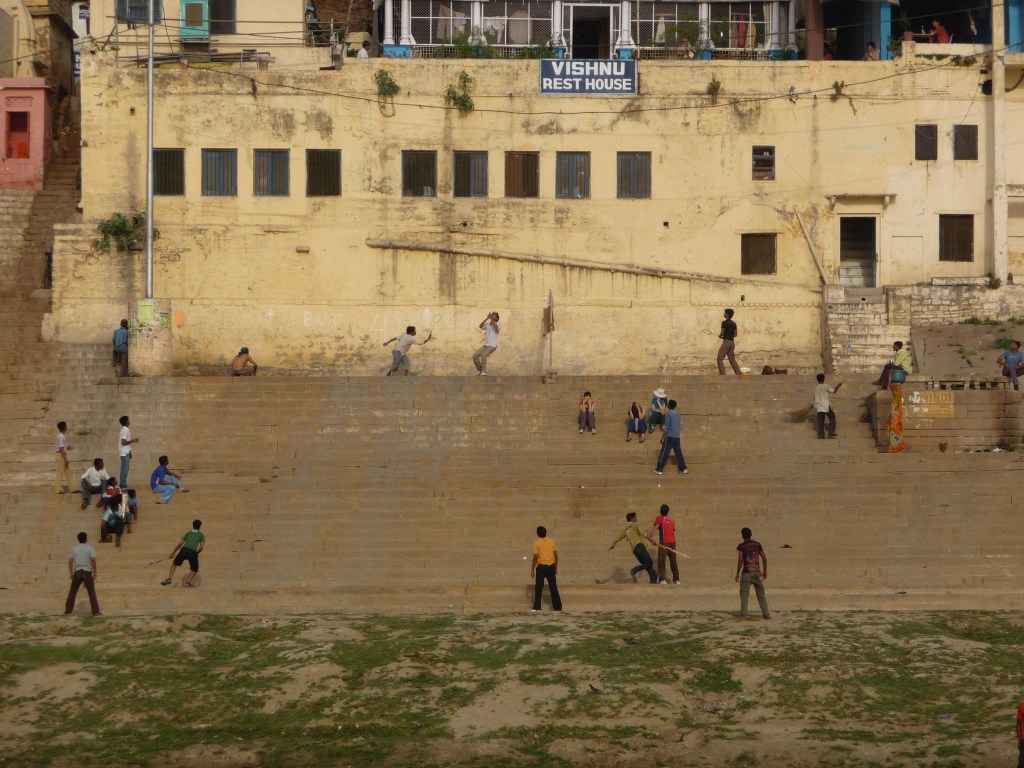
Everything, but everything, happens in and beside the Ganges here during daylight hours and well into the night. Morning ablutions decorously effected under saris and dhotis; teeth scrubbed with fingers or twigs. Playtime for kids racing each other in splashy swims across the river. A cool dip in the heat of the day, an open-air Turkish bath for groups of men relaxing briefly from the toils of getting on in their lives. Dogs patrolling the riverside detritus, barking and fighting over spoils and territory. Stray cattle, a ubiquitous presence on the subcontinent, foraging amongst the garbage and leftovers on the foreshore. Games of cricket improbably taking place along the ghats, the iconic wide steps that form Varanasi’s riverfront: if the ball lands in the water, the batsman’s out, I was told, and some poor child jumps in to find it. Dhobi-wallahs washing and beating the city’s laundry against flat rock “wash-boards”, nauseatingly close to outflow pipes, and hanging it out to dry in serried ranks of matching items on the steps, slopes and railings above. Everywhere puja – personal worship – for the faithful, each supplicant alone in the crowds with their prayers and their offerings. And, at two dedicated ghats, funeral pyres, the last rites for the physical body.

If there’s one thing for which Varanasi is renowned, it’s the burning ghats: incredulous Western voyeurism at conducting in public what we prudishly consider a private ritual. Yet for us, it is simply about the disposal of the body, an alternative to burial or donation to science. In Hinduism, by contrast, the act of cremation itself is of huge spiritual significance, the means by which the soul severs its ties with the body and continues its quest for moksha, freedom from the cycle of birth and rebirth. Cremation on the ghats at Varanasi is the most auspicious, the soul achieving moksha without any further incarnation.
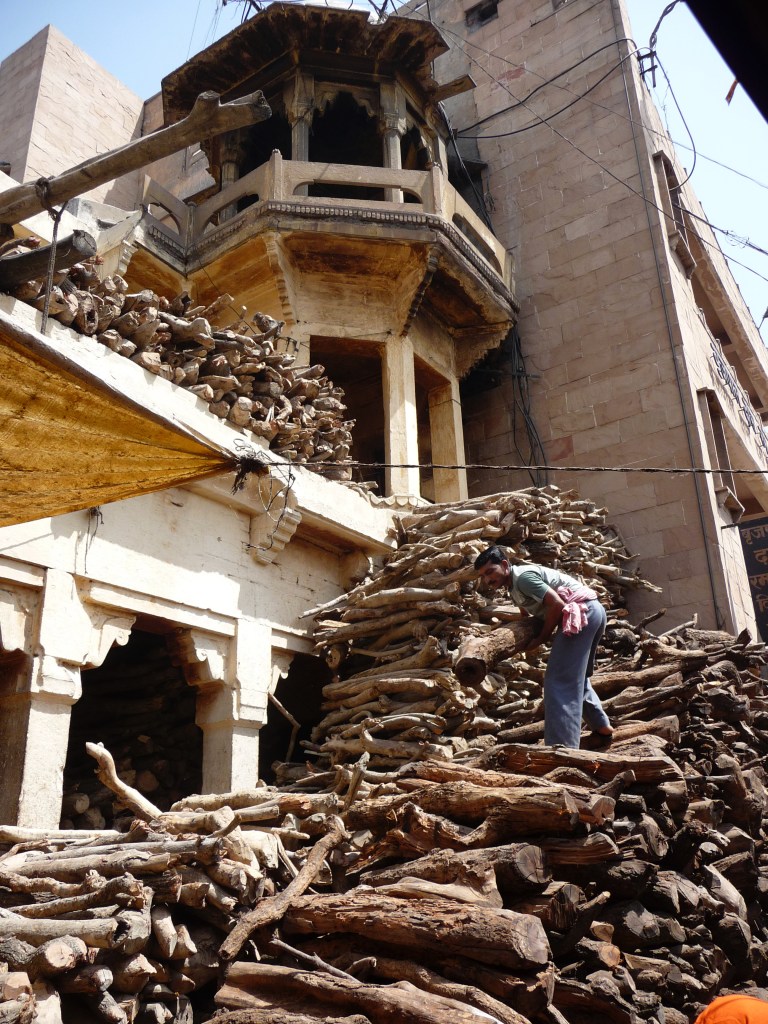
That said, it’s also a practical matter. Wood is piled high in the galis around the ghat, brought in from across the river and even from across the seas, ready to be weighed on antique scales and carried down to a particular pyre. Different woods for different people, for different castes, for differing wealth. As a rough rule of thumb, I was told, a funeral pyre takes about 200 kg of wood and costs a minimum of 3,000 rupees. Electric cremation is much cheaper – 500 rupees – and quicker, but is not considered as effective at liberating the soul.
The body is wrapped in white cloth, laid on a bamboo stretcher, and covered in gorgeous reds and golds, before being carried high on shoulders through the galis, the alleys so narrow and twisting you can inadvertently walk straight into a funeral procession on turning a corner too abruptly (and I did, twice). Only the men of the deceased’s family and acquaintance are involved in this final stage of life; a woman’s tears are said to constrain the soul and prevent it leaving the body. On a practical level, it removes the opportunity for sati – the widow immolating herself on her husband’s pyre – which is now outlawed. Pyres are constructed by the Doms, a sub-caste of Dalits – formerly known as “untouchables” in India’s caste system – who meticulously manage the entire process. The body, once immersed a final time in the Ganges, is laid on top, and the pyre lit from an eternal flame that is carefully tended at a nearby temple. Burning takes three hours, I’m told – not because, I macabrely imagine, that is how long it takes to cremate a human body completely, but because there’s probably a queue for that pyre. Friends and relations stand by while it burns. It is said that a woman’s hips and a man’s chest do not burn, so these are thrown into the river for the fish to consume. Humans eat the fish, and so the cycle of life continues. Certain people are not cremated because they are considered inherently pure. They include sadhus (wise men), children under nine and pregnant women, and those who have died from snake bites, leprosy or smallpox, these conditions being thought to have caused such levels of suffering as to have generated the requisite degree of purity before death. At Harishchandra Ghat, people of any religion may be cremated; the main burning ghat, Manikarnika, is only for Hindus.

And anyone who has spent any time at either of the burning ghats will be able to reel off the same information. It’s as if the locals are programmed with the same “Top Ten Facts About Cremation For Tourists”. Whether you are then persuaded to part with a few rupees in gratitude for this unsolicited information is up to you. Sunil, an engineering student at Benares University, emphatically did not want to be paid. “In India, many sad, bad, good, kind people,” he tells me philosophically. He says he simply enjoys meeting people and practising his English. After running through the Top Ten Facts, he takes me up to the balcony of a nearby temple from which, in the new darkness of the evening, I count no fewer than fourteen pyres burning, whether already “occupied” or not. When we return to ground level, he urges me to climb the steps to the topmost level of the ghat where only Brahmins, the highest caste, may be cremated. He brushes off my very British reticence – “Are we not intruding? Do the relatives not mind?” – as we skirt a very conspicuously occupied pyre, the body silhouetted against the flames. On the far side, the dozen or so men look oddly uninterested in the pyre before them. Blank-faced. In grief, in denial, or inured to the process?
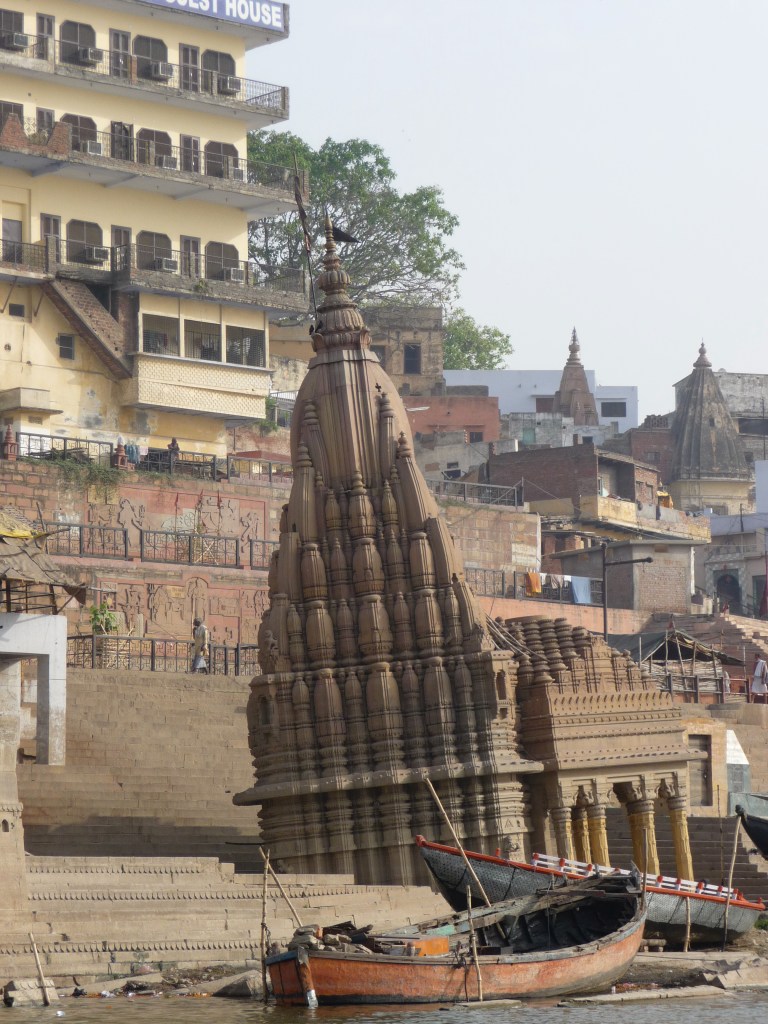
There is a curious atmosphere at Manikarnika Ghat. Perhaps it is its more confined location – at a bend in the river, blocked in by surrounding buildings and temples – that makes it the more intense of the two burning ghats to visit. Around me, spectators, tourists, relatives, workers, monks, dogs, cattle, those seeking a commercial opportunity… An urgent cry goes up: a particularly large and determined cow, calf in tow, is heading down the steps and the crowd scatters. A pyre flares, flames reaching a couple of metres into the air, and a camera flashes intrusively (an Indian tourist breaking the no-camera rule, I’m relieved to note, limiting my vicarious embarrassment). I ask Sunil why he and his friends come down to the burning ghats in the evening. “Because there’s always something going on,” he replies, pragmatically. This for the tourist, though, is the Varanasi Conundrum. In visiting the burning ghats, are we unwelcome voyeurs? Or accepted, tolerated, even necessary – because of our obvious commercial value? Are we also participants? Do we slip over from one to another?

For a different perspective and a welcome breath of fresher air, I took boat trips on the Ganges at both dawn and dusk. From the river, the noise and crowds are muted, and the city’s erstwhile grandeur stands out, many a maharaja and prince of note having once built ornate palaces along the river’s edge. For me, the morning trip is the more magical, watching the city slowly open its eyes to the coming day, gradually shaking out the sleep and warming up in the rising sun. The haze never really disperses here, its effect on the chaotic and built-up riverbanks, disappearing in the distance either side of us, is ethereal, emphasising the timelessness of this heart of India. Even the tourists in their boats are silent, the morning too new for conversation. A lone puja flower offering drifts silently past on the mirror-like surface of the river. Monkeys scamper across rooftops. A pigeon flaps heavily past, weighed down by a strand of marigolds rescued from an offering or a funeral pyre, now destined for its nest. The Ganga Supermarket approaches: a boat laden with tourist memorabilia is being paddled towards us, but the enterprising oarsman has no takers. A fisherman hangs his catch over the side of his boat to keep it fresh. A passing tourist reports a dolphin sighting – incredible that there might be any life in this river, pollution and all. We pause for a welcome chai, the hot sweet milky liquid disproportionately delicious at this hour of the morning, although the thin plastic beaker is so flimsy I have to hold it with both hands to stop it crumpling before I finish the contents.
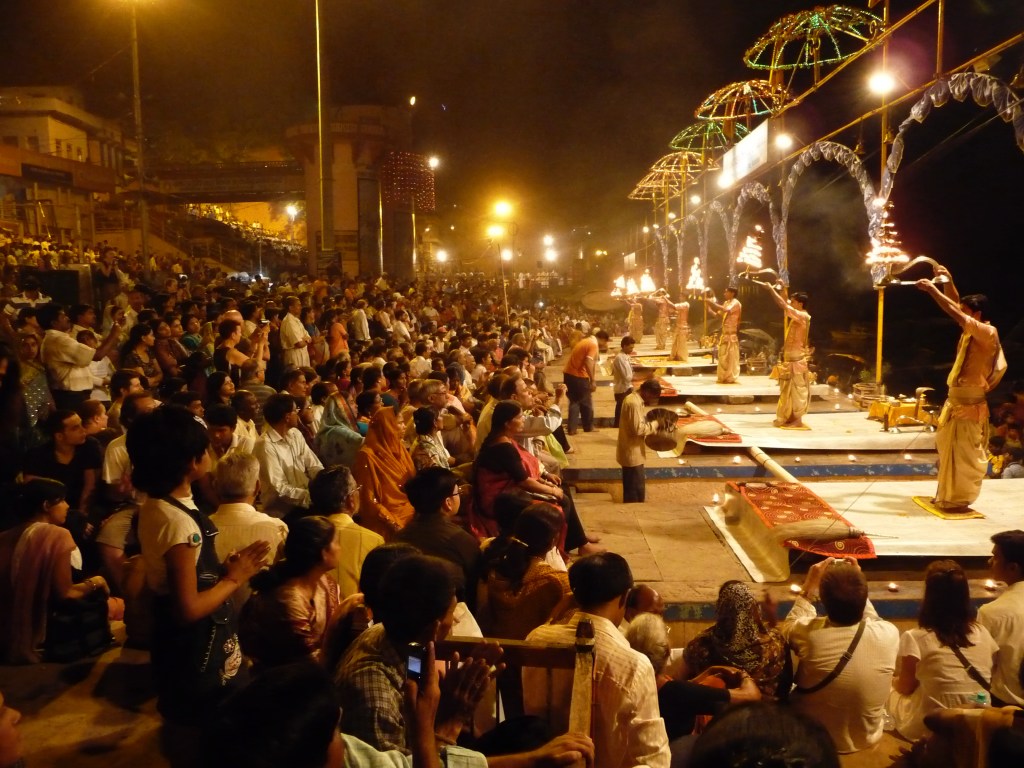
In the evening, it’s all colour, noise and light, with the ganga aarti ceremony at Dasaswamedh Ghat the focus of attention. Tourist boats converge, looking, from the shore, like a water-borne refugee crisis. Candle offerings on banana leaves float flickeringly past. On land, the steps are crowded with spectators, the women’s saris and salwar kameez dazzling explosions of colour amidst their menfolk’s muted attire. Smoke from the lamps and intoxicating aromas from the priests’ incense waft over us. Drums beat rhythmically. The priests work in unison on their individual platforms as they ask the gods for blessings on us all at the day’s end. I can feel myself becoming lightheaded on the atmosphere and the hypnotic cadences of the chanting and the drumming.

Looking at the timelessness of the ceremonies in front of me that first evening, I struggled to believe that, only the morning before, I was drinking coffee at home in the chill of London.
In the twenty-first century.
Postscript: I wrote the original version of this blog in April 2010, but I amended it for submission to a competition run by TripFiction in November 2020 for short pieces conveying “a sense of place”. I was delighted to hear that I’d come in the top ten, with the competition attracting nearly 400 entries from 35 countries.
 Travels of a Reluctant Lawyer